Family Asteraceae Life cycle Perennial Blooms Summer · Fall Height Usually 4–8 feet; sometimes taller Light & soil Full sun · Good Drainage; Moist; Occasionally Dry
Common names Tall Coreopsis · Golden Crown · Tall Tickseed
Bloom season is a general guide; timing and mature height vary by region and conditions. Sources: NC State Extension.
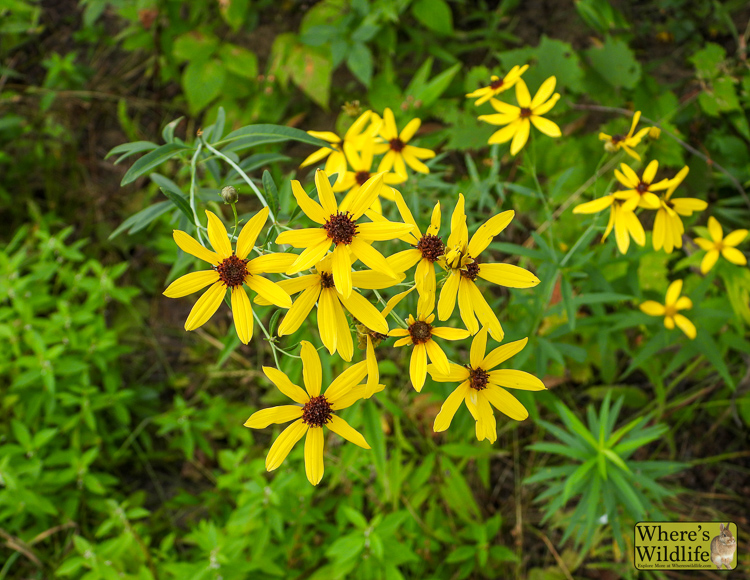
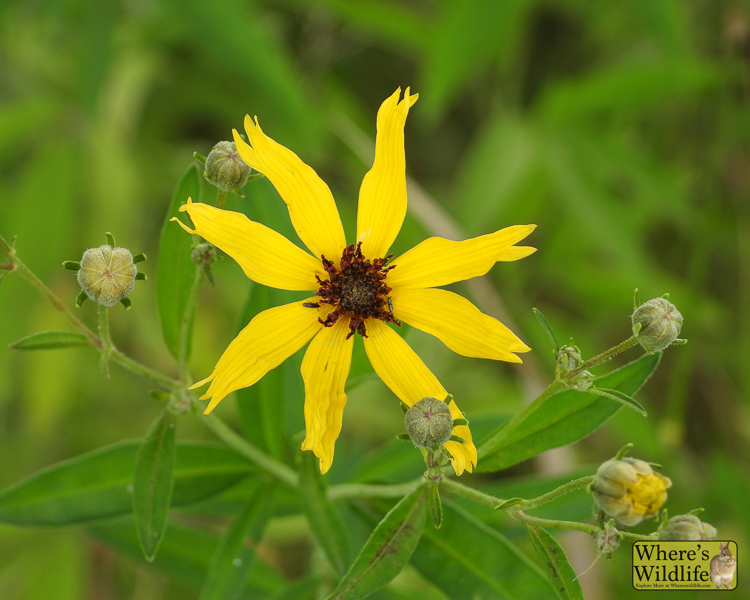
A Tall Coreopsis bloom with narrow yellow rays and a dark center.
Compare Tall and Prairie Coreopsis
Check the leaves, flower centers and overall height together. Select either photograph to visit its flower page.
Tall Coreopsis
Anacis tripteris (syn. Coreopsis tripteris)
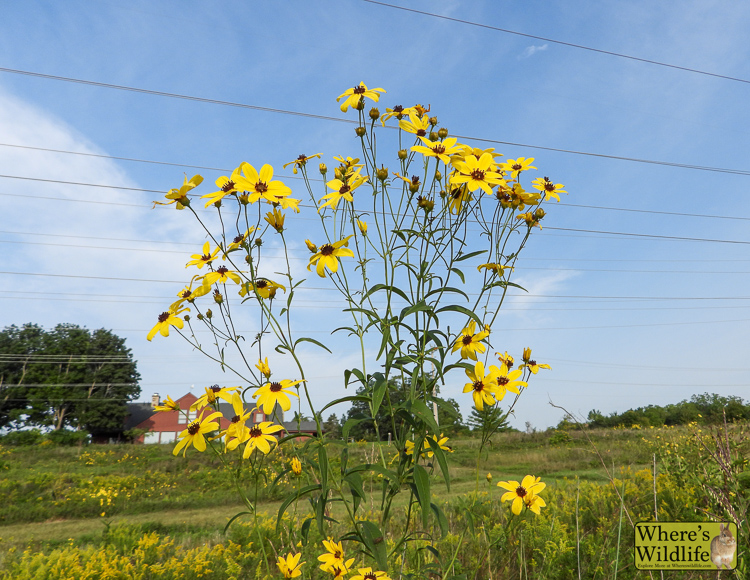
Usually much taller, with reddish-brown to purplish flower centers. Most stem leaves are divided into three separate leaflets; upper leaves may be undivided.
Prairie Coreopsis
Coreopsis palmata
Usually shorter, with yellow flower centers when fresh. Leaves are typically deeply divided into three narrow lobes that remain joined as one leaf blade. Aging flower centers can darken, so check the leaves too.
How to recognize it
Key identification features
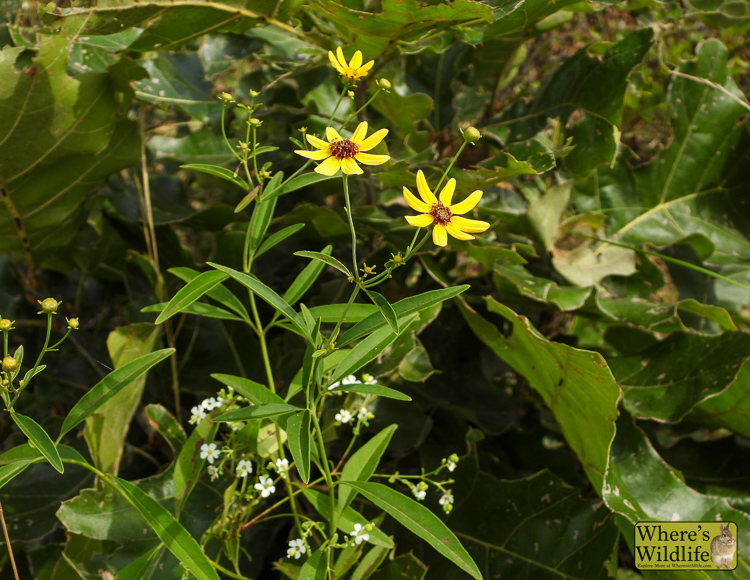
Look for opposite leaves with three, sometimes five, narrow leaflets. Upper leaves may be simple. Slender stems branch near the top, carrying yellow flower heads with dark maroon centers.
Where and when to look
Search prairies, savannas, open woodland edges and meadows from midsummer into early autumn. It often grows in moist to moderately moist ground and can reach well above head height.
Compare the sunflowers
Left: a three-leaflet Tall Coreopsis leaf. Right: one simple leaf of Woodland Sunflower (Helianthus divaricatus).
Check middle and lower leaves: Tall Coreopsis can have simple upper leaves too. Use the leaves together with the flowers and growth habit.
A closer look
Small flowers in a dark disk
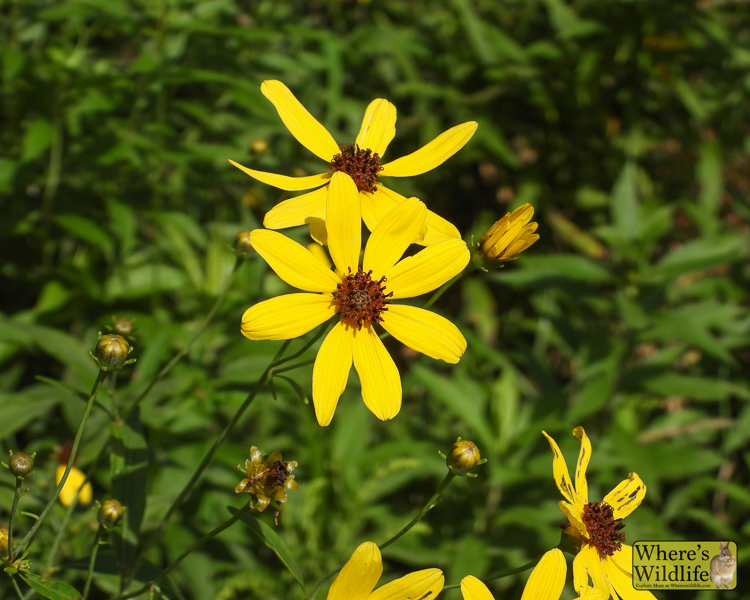
Usually eight rounded yellow ray florets surround a dark disk made of many small tubular flowers. In this close-up, the open disk florets show their tiny spreading tips. Fruits later develop from the disk flowers.
A spreading prairie colony
Underground rhizomes let Tall Coreopsis spread into loose colonies. Neighboring stems may be connected below ground. The illustration shows the above-ground patch; its underground connections cannot be confirmed from a surface view alone.
A meeting place for insects
Bumblebees and other insects visit the flower heads for nectar or pollen. Watch how a visitor moves among the small disk florets. Wasps, flies, butterflies and beetles may visit too.
Educational artwork created with AI for Where’s Wildlife. Select an artwork image to enlarge it.
Range & sightings
Native to parts of North America, including the United States.
Reported U.S. distribution AL, AR, CT, DC, FL, GA, IA, IL, IN, KS, KY, LA, MA, MD, MI, MO, MS, NC, NY, OH, OK, PA, RI, SC, TN, TX, VA, WI, WV
State records describe documented distribution, not presence in every county. A state record alone does not establish that every population there is native. The observation map shows reported sightings and may include cultivated plants.