WHERE’S WILDLIFE • WILDFLOWER FIELD GUIDE

Hog Peanut

Amphicarpaea bracteata
NATIVE • WOODLAND VINE

At a glance

Family   Fabaceae · pea family
Life cycle   Annual, short-lived perennial
Blooms   July–September (Upper Midwest)
Vine length   1–5 feet
Light & habitat   Part shade, shade; moist woods, thickets

Common names
Hog Peanut

Bloom timing and vine length vary with location and growing conditions. Sources: Minnesota Wildflowers.

Range Map

Explore photographed sightings and their locations.

View photos & full species guideHide photos & full species guide

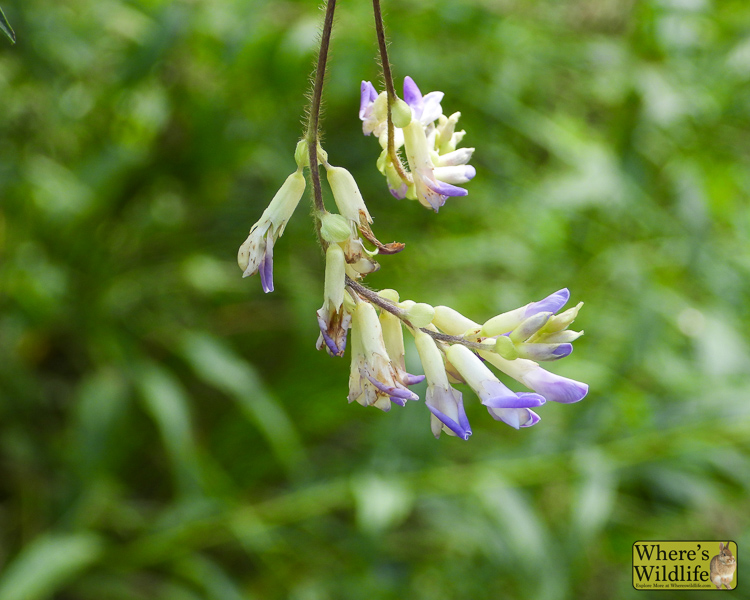
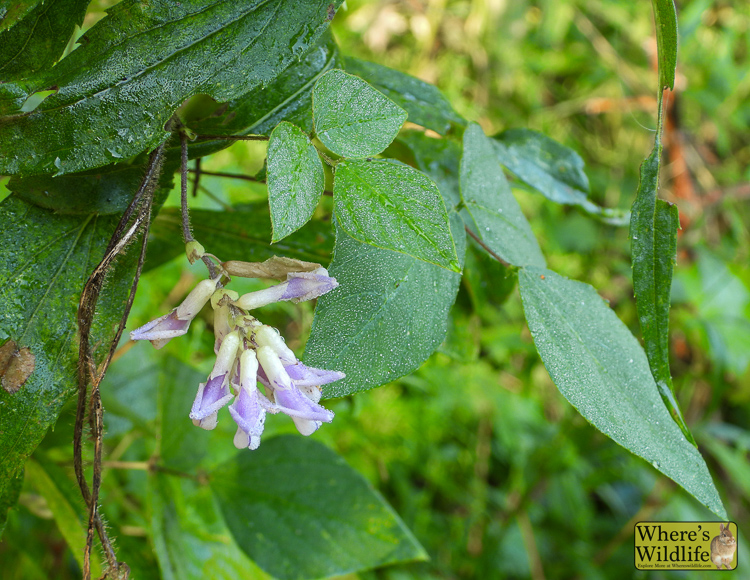
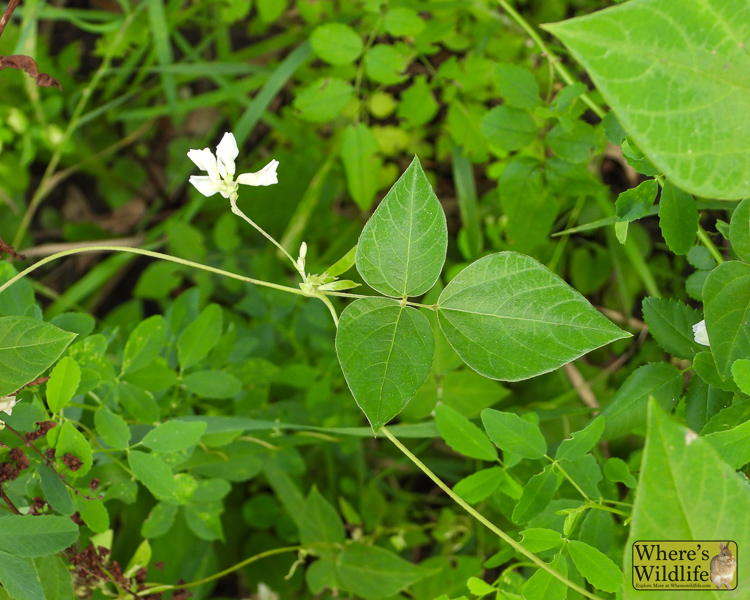
Field photographs

Compare flowers, foliage and the plant in its habitat. Select any photo to enlarge it.

How to recognize it

Key identification clues

Follow one leaf stalk out from the slender vine. It ends in three pointed leaflets with smooth edges. The middle leaflet has a longer stalk of its own. A separate stalk grows from the junction of leaf and stem and carries a small cluster of white to pale violet pea flowers.

Look for Hog Peanut in moist woods and thickets, often in partial shade or shade. Its vines wind through nearby vegetation. Flowering is generally from July through September in the Upper Midwest, varying with location and weather.

Compare Groundnut

Count the leaflets on one complete leaf. Hog Peanut, on the left, has three. Groundnut, on the right, usually has five or seven. In bloom, Groundnut carries tight clusters of dusky rose to maroon flowers.

A closer look

Two kinds of flowers

The flowers you can spot on the upper vine open above the leaves or hang among them. Tiny flowers on runners at ground level stay closed and fertilize themselves. Each can produce a fleshy, single-seeded fruit just beneath the soil. The artwork shows the two views at different scales.

Climbing without tendrils

Trace the green stem as it winds around the woody twig. The stem itself holds the vine up. Look for a three-leaflet leaf attached along the coil.

Pods on the upper vine

Flat, pointed pods develop in the upper flower clusters. Each usually holds three or four seeds. In the tenth field photograph below, you can see young green pods hanging beside faded blossoms.

Educational artwork created with AI for Where’s Wildlife. Select an artwork image to enlarge it.

Range & sightings

Native to parts of North America, including the United States.

Reported U.S. distribution
AL, AR, CT, DC, DE, FL, GA, IA, IL, IN, KS, KY, LA, MA, MD, ME, MI, MN, MO, MS, MT, NC, ND, NE, NH, NJ, NY, OH, OK, PA, RI, SC, SD, TN, TX, VA, VT, WI, WV, WY

State records describe documented distribution, not presence in every county. A state record alone does not establish that every population there is native. The observation map shows reported sightings and may include cultivated plants.

Distribution source: USDA PLANTS.

Observations show reported sightings; they do not define the plant’s complete native range.

Keep learning

Study the photographs and field notes for Hog Peanut, then practice identifying this and other wildflowers in the quiz.

Share this:

Like this:

Like Loading…