WHERE’S WILDLIFE • WILDFLOWER FIELD GUIDE

White Snakeroot

Ageratina altissima
NATIVE • WILDFLOWER

At a glance

Family   Asteraceae · aster family
Life cycle   Perennial
Blooms   July–October (Upper Midwest)
Height   1–4 feet
Light & habitat   Part shade, shade; thickets, deciduous woods

Common names
White Snakeroot

Bloom timing and mature height vary with location and growing conditions. Sources: Minnesota Wildflowers.

Range Map

Explore photographed sightings and their locations.

View photos & full species guideHide photos & full species guide

Field photographs

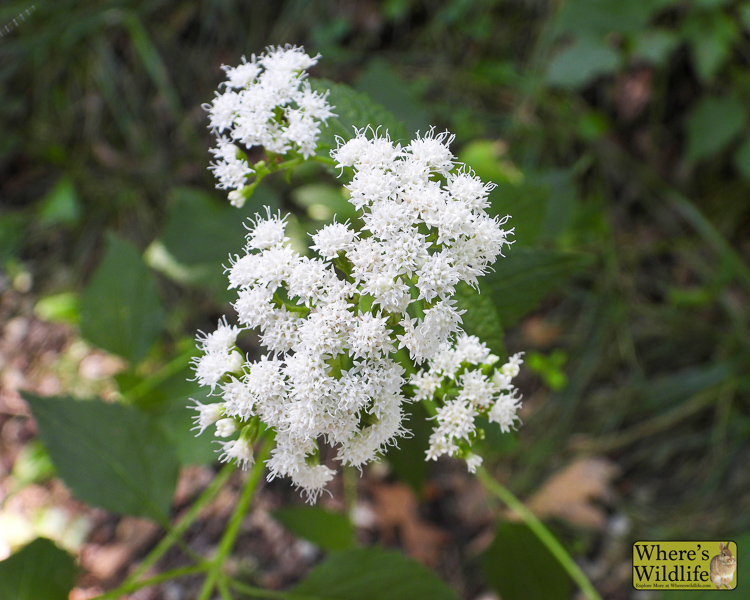
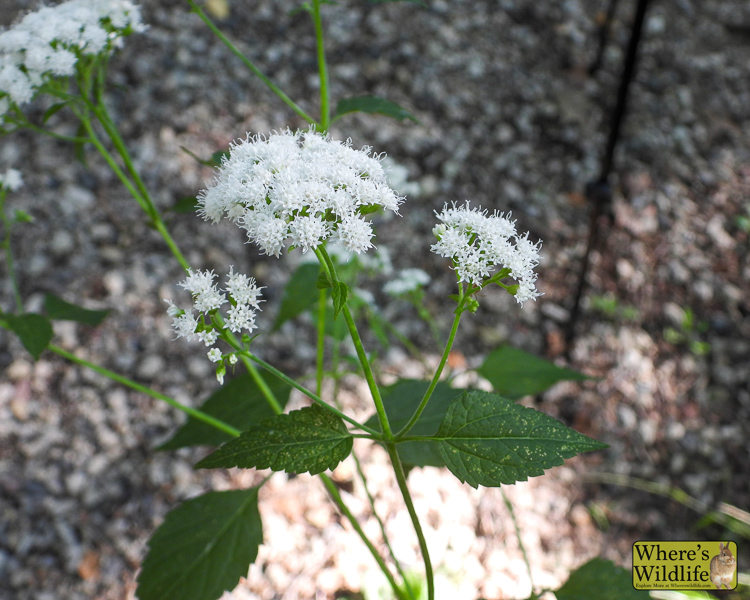
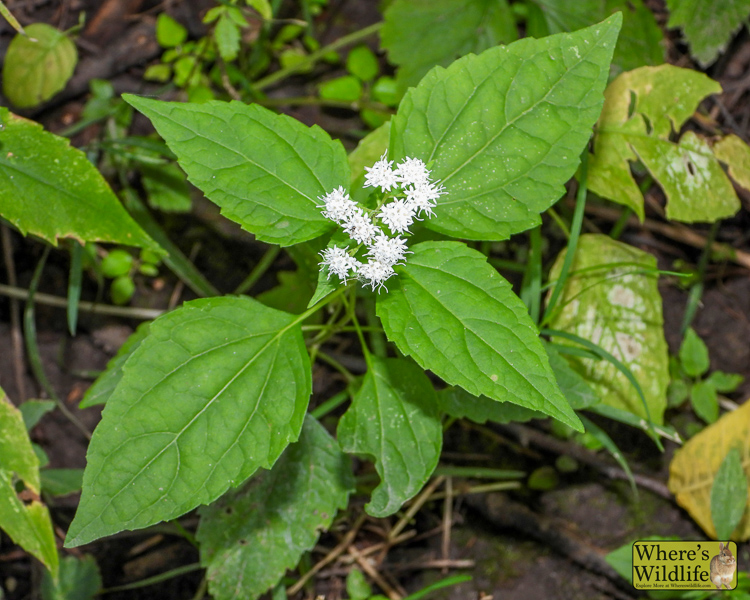
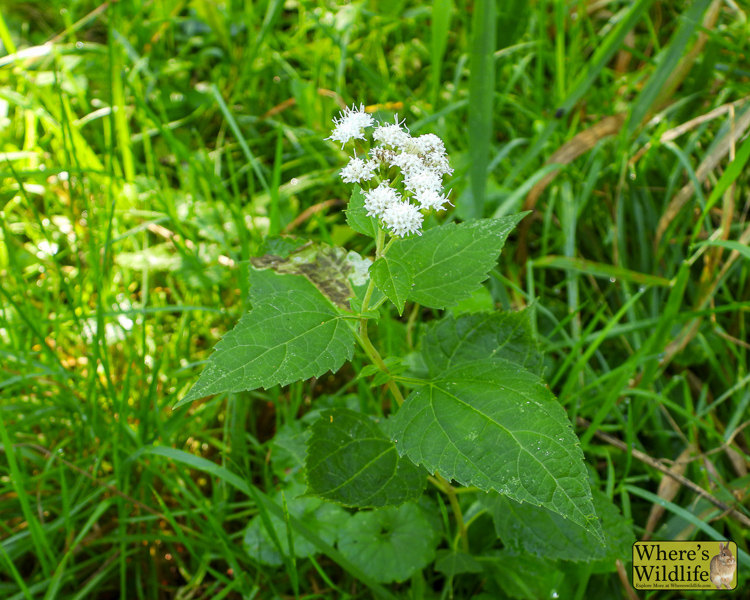
Compare flowers, foliage and the plant in its habitat. Select any photo to enlarge it.

How to recognize it

Key identification clues

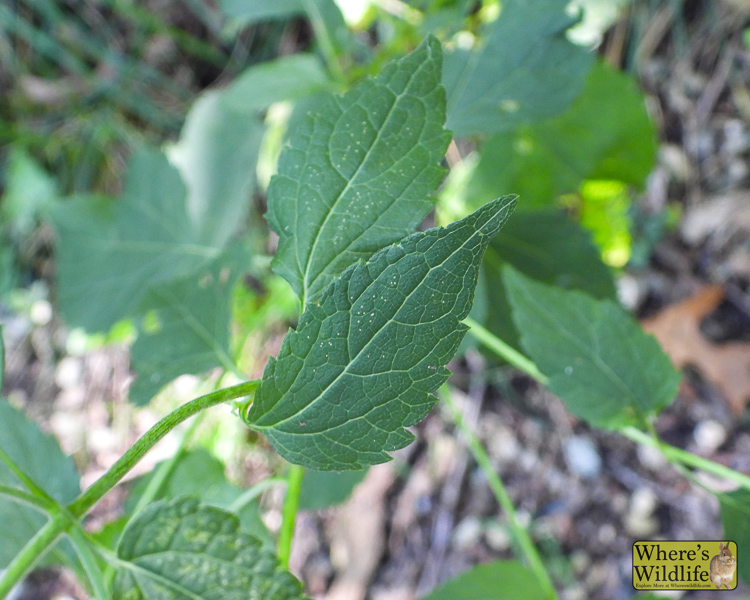
Trace a white cluster down to the branching stem. Each tuft is a small head made of many tubular flowers. Below the clusters, look for opposite pairs of broad, pointed leaves with coarse teeth. Each leaf has its own stalk.

Where and when to look

In late summer and early fall, look along shady woodland paths, thicket edges and openings in deciduous woods. The white clusters often catch the light before the leafy stems stand out against the understory.

Use leaves to compare similar flowers

Follow a lower leaf to the stem. White Snakeroot has broad, toothed leaves on separate stalks. Common Boneset has narrower leaves whose bases usually join around the stem, so the stem appears to pass through a pair.

Compare Common Boneset

A closer look

Why the heads look fluffy

Look closely at one white tuft. It is a head of tiny disk florets, each with five short lobes at the mouth of its tube. The fine white threads curling above the tubes are forked styles. There is no outer ring of petal-like rays.

Small fruits travel on the wind

Later in the season, the heads dry and open to reveal slender, dark, one-seeded fruits. A tuft of pale bristles grows directly from the tip of each fruit and helps the wind carry it away.

Wildlife value and toxicity

Bees and small butterflies visit the flower heads, and songbirds eat the seeds. The plant is poisonous to people and livestock if eaten.

Educational artwork created with AI for Where’s Wildlife. Select an artwork image to enlarge it.

Range & sightings

Native to parts of North America, including the United States.

Reported U.S. distribution
AL, AR, CT, DC, DE, FL, GA, IA, IL, IN, KS, KY, LA, MA, MD, ME, MI, MN, MO, MS, NC, ND, NE, NH, NJ, NY, OH, OK, PA, RI, SC, SD, TN, TX, VA, VT, WI, WV

State records describe documented distribution, not presence in every county. A state record alone does not establish that every population there is native. The observation map shows reported sightings and may include cultivated plants.

Distribution source: USDA PLANTS.

Observations show reported sightings; they do not define the plant’s complete native range.

Keep learning

Study the photographs and field notes for White Snakeroot, then practice identifying this and other wildflowers in the quiz.

Share this:

Like this:

Like Loading…