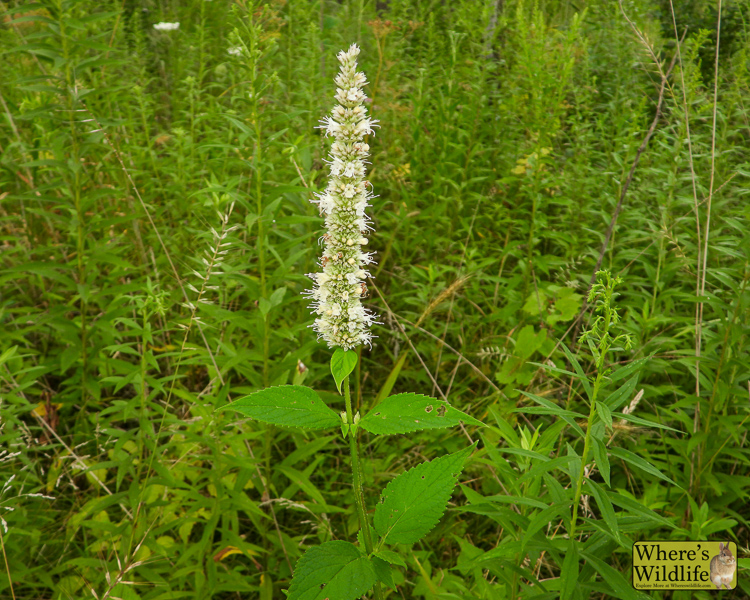
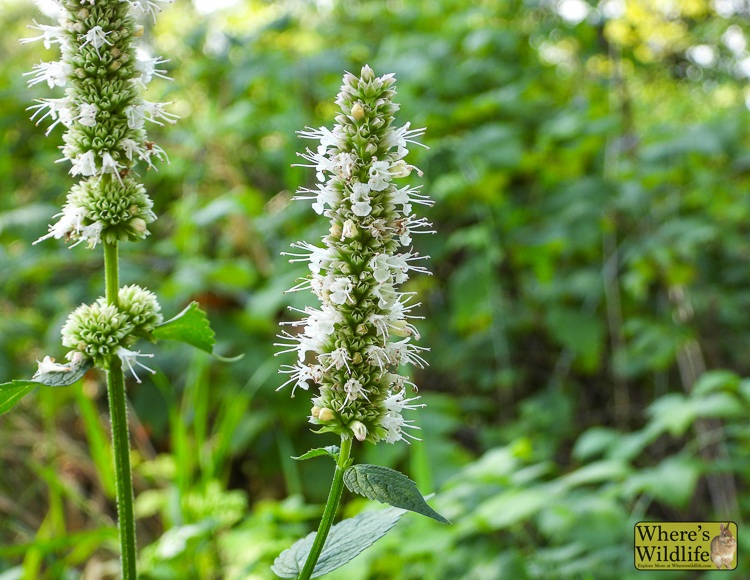
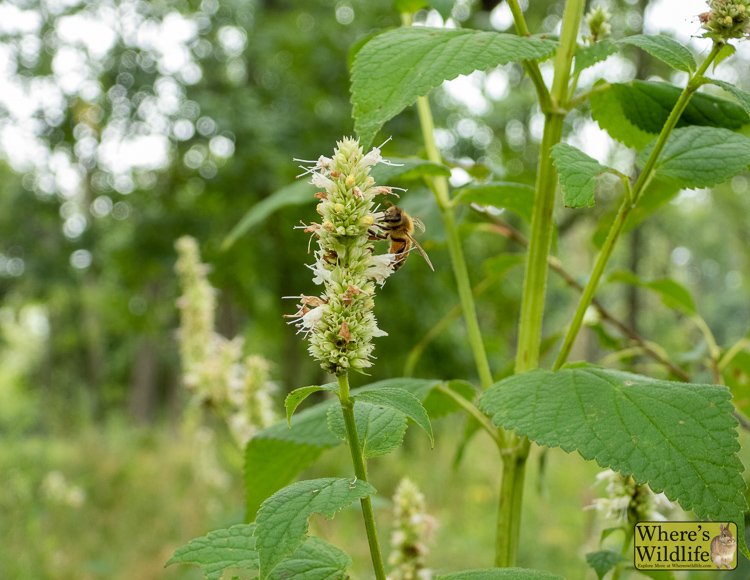
Purple Giant Hyssop’s toothed green leaves growing in opposite pairs along a stem.
How to recognize it
Follow a flower spike to the leafy stem
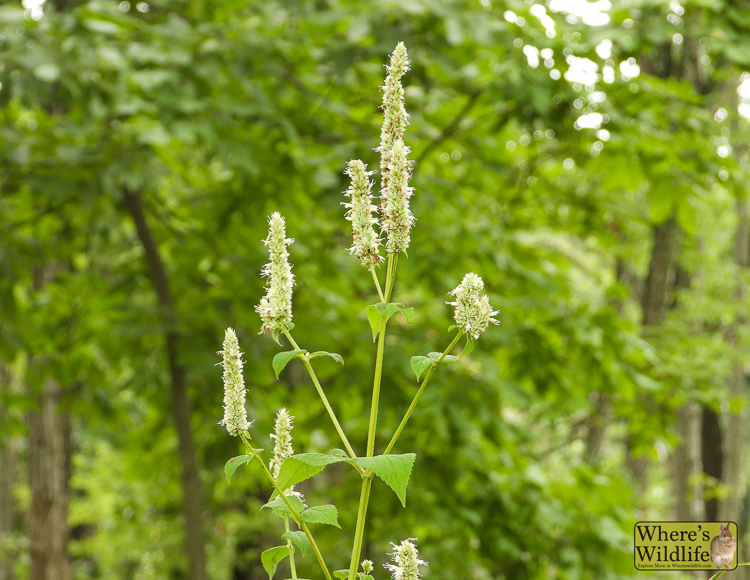
Follow the main flower spike down to the first pair of toothed leaves. Two side branches often rise from the same node and end in smaller spikes. The field photographs here show nearly white flowers. Other plants can bloom pale pink or lavender.
Where and when to look
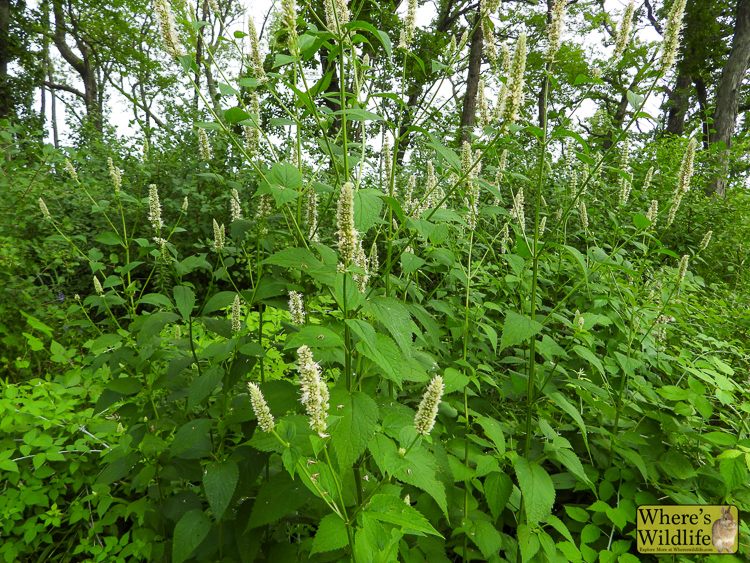
Look where sunlight reaches the floor of rich woods, along a thicket edge, or in a woodland clearing. In the Upper Midwest, look for flowering spikes in July and August. The tallest stems can reach about six feet.
Compare several stages on the same spike
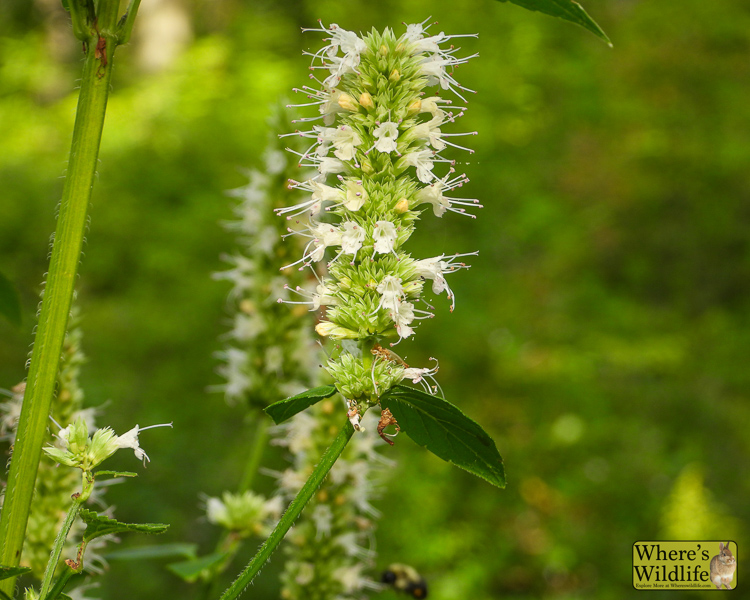
Look along one spike for unopened buds, open flowers and curled brown remnants. The small green cup around each flower is its calyx. Its edges may carry a little color even when the rest of the cup is green.
A closer look
Four stamens project from each tube
Each flower is only about a quarter of an inch long. Look from the side to see four fine stamens reaching beyond its mouth. The lower lip curves down and has three lobes, with the broadest lobe in the middle.
Opposite leaves have coarse teeth
Two broad, toothed leaves meet at each node on the square stem. Turn one over. Purple Giant Hyssop has a green underside, sometimes with fine hairs along the veins. Blue Giant Hyssop usually has a whitish, softly hairy underside.
This plant shows the pale lavender flowers that also occur in this species. Look for branching stems with several narrow spikes rising above the surrounding woodland plants. The field photographs above show how subtle those spikes can look among other tall herbs.
Educational artwork created with AI for Where’s Wildlife. Select an artwork image to enlarge it.
Range & sightings
Native to parts of North America, including the United States.
Reported U.S. distribution CT, DC, DE, GA, IA, IL, IN, KS, KY, MA, MD, MI, MN, MO, NC, NE, NH, NJ, NY, OH, PA, SC, SD, TN, VA, VT, WI, WV
State records describe documented distribution, not presence in every county. A state record alone does not establish that every population there is native. The observation map shows reported sightings and may include cultivated plants.