WHERE’S WILDLIFE • WILDFLOWER FIELD GUIDE

Common Boneset

Eupatorium perfoliatum

Pronunciation: yoo-puh-TOR-ee-um per-foh-lee-AY-tum

Common Boneset field photograph. Tap the photo to enlarge.

NATIVE • WILDFLOWER

At a glance

Family   Asteraceae · aster family
Life cycle   Perennial
Blooms   July–October (Upper Midwest)
Height   2–4 feet
Light & habitat   Sun; moist fields, along shores

Common names
Common Boneset

Bloom timing and mature height vary with location and growing conditions. Sources: Minnesota Wildflowers.

Sightings map

Explore reported observations. Sightings are not a complete range map.

Field photographs

Compare flowers, foliage and the plant in its habitat. Select any photo to enlarge it.

How to recognize it

Fluffy white clusters

Small tubular florets form broad branching clusters. Long projecting styles give the heads a fluffy appearance.

Joined leaf bases

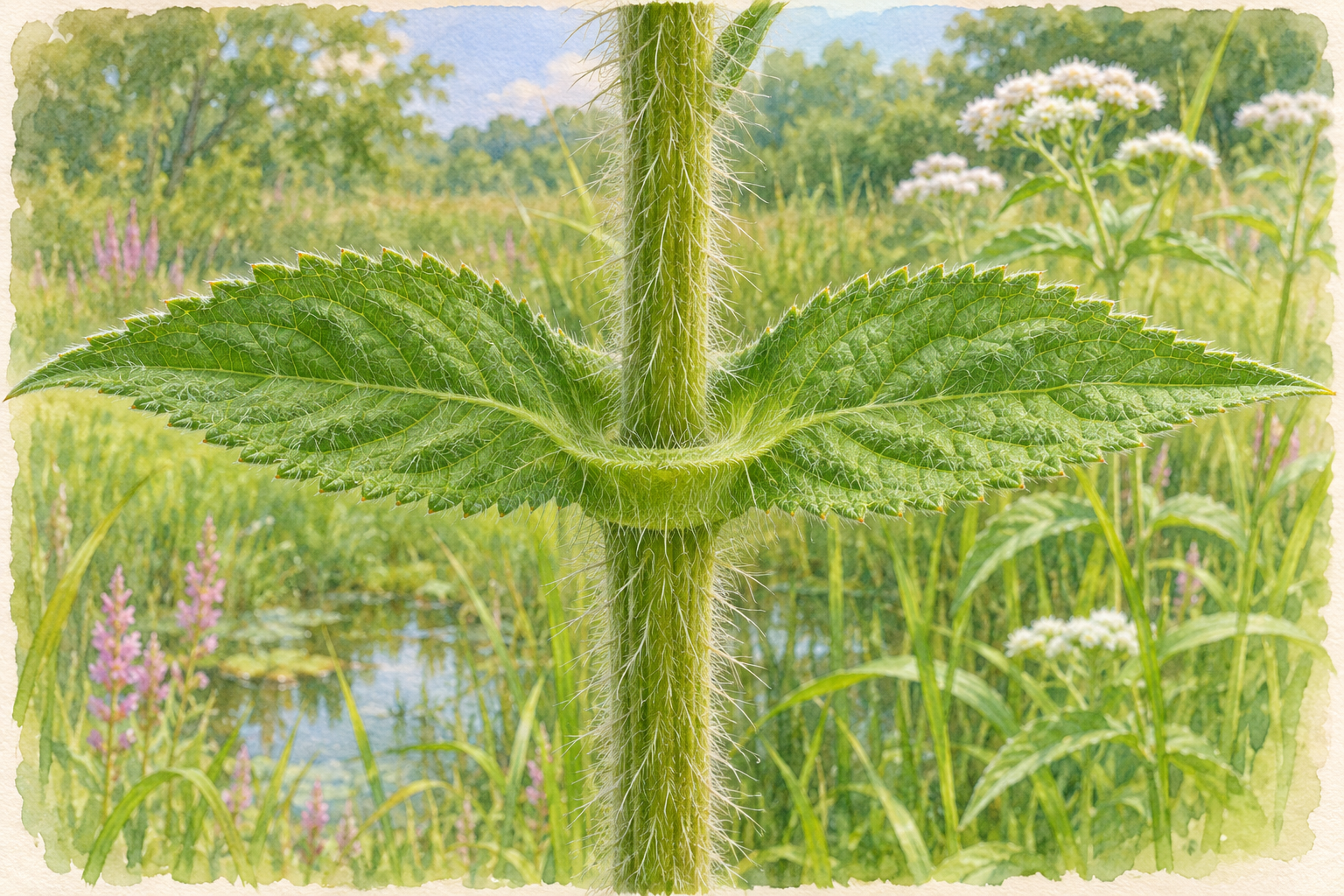
Opposite leaves join around the stem, making it appear to pass through one large leaf. Check a mature middle pair.

Wrinkled leaves, hairy stems

Long tapering leaves have toothed edges and a wrinkled surface. Spreading hairs cover the upright stems.

A closer look

What perfoliate means

The stem appears to pass through a leaf. Here, two opposite leaves join at their broad bases to create that effect.

Many flowers, many visitors

Bees, flies, wasps and butterflies visit the small flower heads for nectar or pollen.

Where and when to look

Look in sunny wet meadows, fens, seeps, marsh edges and damp ditches. Upper Midwest flowering generally falls between July and October.

Through the seasons: Rhizomes help form colonies. After flowering, small fruits develop tufts of hairs that aid wind dispersal.

Compare to similar species

Common Boneset

Eupatorium perfoliatum

Joined leaf bases and wrinkled, toothed leaves.

This species

Tall Boneset

Eupatorium altissimum

Separate leaf bases and narrow, three-veined leaves.

View species guide →

Late Boneset

Eupatorium serotinum

Broader, coarsely toothed leaves with distinct stalks.

View species guide →

The leaf attachment is the clue. Common Boneset’s opposite leaf bases join around the stem; those of Tall and Late Boneset remain separate.

Range & sightings

Native to parts of North America, including the United States.

Reported U.S. distribution
AL, AR, CT, DC, DE, FL, GA, IA, IL, IN, KS, KY, LA, MA, MD, ME, MI, MN, MO, MS, NC, ND, NE, NH, NJ, NY, OH, OK, PA, RI, SC, SD, TN, TX, VA, VT, WI, WV

State records describe documented distribution, not presence in every county. A state record alone does not establish that every population there is native. The observation map shows reported sightings and may include cultivated plants.

Distribution source: USDA PLANTS.

Observations show reported sightings; they do not define the plant’s complete native range.

Keep learning

Study the photographs and field notes for Common Boneset, then practice identifying this and other wildflowers in the quiz.

Share this:

Like this:

Like Loading…