Family Asteraceae Life cycle Perennial Blooms Late spring (Midwest) Height Flowering stems 9–24 inches Light & habitat Full to partial sun; moist to somewhat dry loam, sand or rocky soil
Common names Roundleaf Ragwort · Spoon-leaved Ragwort
Bloom timing and mature height vary with location and growing conditions. Sources: Illinois Wildflowers.
Explore photographed sightings and their locations.
View photos & full species guideHide photos & full species guide
Field photographs
Compare flowers, foliage and the plant in its habitat. Select any photo to enlarge it.
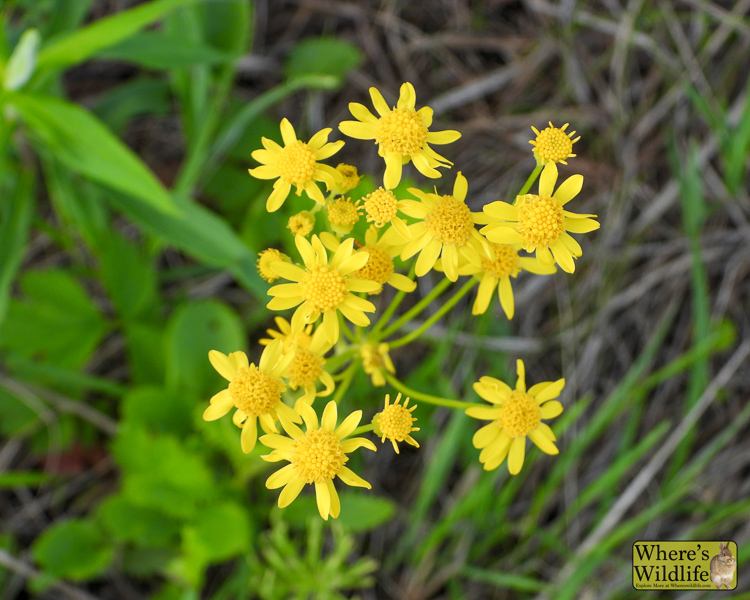
Roundleaf Ragwort’s yellow flower cluster viewed from above.
Roundleaf Ragwort’s golden blossoms on branching stems.
How to recognize it
Key identification clues
Look for smooth basal leaf blades that are round to spoon-shaped, with toothed or scalloped edges. Flowering stems carry a few deeply lobed leaves and a broad cluster of yellow heads.
Where and when to look
Look in open rocky woods, savannas, bluff edges and limestone glades, in full to partial sun. Roundleaf Ragwort tolerates moist to somewhat dry conditions. In the Midwest, flowering is generally in late spring; timing varies with location and weather.
Range & sightings
Native to parts of North America, including the United States.
Reported U.S. distribution AL, AR, CT, DC, FL, GA, IL, IN, KS, KY, LA, MA, MD, MI, MO, MS, NC, NH, NJ, NM, NY, OH, OK, PA, RI, SC, TN, TX, VA, VT, WV
State records describe documented distribution, not presence in every county. A state record alone does not establish that every population there is native. The observation map shows reported sightings and may include cultivated plants.
Observations show reported sightings; they do not define the plant’s complete native range.
A closer look
Two leaf shapes on one plant
Broad basal leaves and raggedly lobed stem leaves belong to the same plant. Photograph the rosette and flowering stalk together to avoid mistaking them for neighboring species.
Yellow heads become fluffy fruits
Both ray and disk flowers develop small dry fruits with white hair tufts. Wind carries these away. Follow a cluster from late-spring bloom into its summer fruiting stage.
Small colonies and insect visitors
Vegetative offsets can form small colonies. Bees and flies visit the flower heads for nectar or pollen. A patch offers opportunities to compare individual plants and observe visitors without picking flowers.
Golden Ragwort has a heart-shaped indentation at the base of its lower leaves. Prairie Ragwort is generally much more cobwebby-hairy at flowering. Check basal leaf shape and hairiness together.