WHERE’S WILDLIFE • WILDFLOWER FIELD GUIDE

Golden Ragwort

Packera aurea
NATIVE • WILDFLOWER

At a glance

Family   Asteraceae · aster family
Life cycle   Perennial
Blooms   May–July (Upper Midwest)
Height   12–30 inches
Light & habitat   Part shade, sun; wet meadows. moist open woods, stream banks, fens, seeps

Common names
Golden Ragwort · Heart-leaved Groundsel

Bloom timing and mature height vary with location and growing conditions. Sources: Minnesota Wildflowers.

Range Map

Explore photographed sightings and their locations.

View photos & full species guideHide photos & full species guide

Field photographs

Compare flowers, foliage and the plant in its habitat. Select any photo to enlarge it.

How to recognize it

Find the heart-shaped basal leaves

Look near the soil for long-stalked leaves with rounded teeth and a distinctly heart-shaped base. Include these leaves with the flowering stem; the yellow heads alone resemble those of several other ragworts.

Where and when to look

Woodland Wildflower
Blooms: May – July

Habitat: Golden Ragwort prefers full sun to light shade with wet to mesic conditions and a soil with abundant organic matter to retain moisture. Look for Golden Ragwort in wet to mesic deciduous woodlands, damp woodland openings, woodland borders, moist sandy savannas, sandy swamps, seeps and edges of springs, banks of rivers and lakes, slopes of rocky ravines, glades, moist meadows, roadside embankments, and abandoned fields.

Range & sightings

Native to parts of North America, including the United States.

Reported U.S. distribution
AL, AR, CT, DC, DE, FL, GA, IA, IL, IN, KY, MA, MD, ME, MI, MN, MO, MS, NC, NH, NJ, NY, OH, OK, PA, RI, SC, TN, TX, VA, VT, WI, WV

State records describe documented distribution, not presence in every county. A state record alone does not establish that every population there is native. The observation map shows reported sightings and may include cultivated plants.

Distribution source: USDA PLANTS.

Observations show reported sightings; they do not define the plant’s complete native range.

A closer look

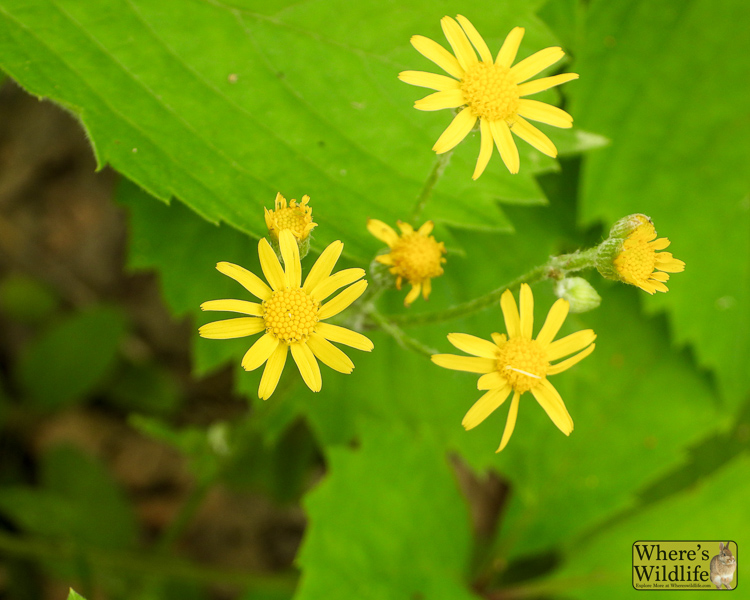
Each yellow head holds many florets

Yellow rays surround a disk of tiny central flowers. A side view also reveals the narrow bracts cupping the head. Photograph one head closely, then the broader, often level-topped cluster.

Stem leaves become deeply divided

Higher leaves are narrower, more lobed, and shorter-stalked or clasping. Follow one stem upward to connect these leaves with the very different basal foliage.

White tufts replace the yellow display

As fruits mature, pale hairs form small fluffy heads. Each dry fruit carries a tuft that aids wind dispersal. A later visit reveals this change even after the yellow rays are gone.

Compare Western Heart-leaved Groundsel

That close relative usually has smaller, more upright basal blades with less strongly heart-shaped bases. Photograph the leaf outline and its posture. Purple-tipped flower bracts alone do not reliably separate the two.

Keep learning

Study the photographs and field notes for Golden Ragwort, then practice identifying this and other wildflowers in the quiz.

Share this:

Like this:

Like Loading…