WHERE’S WILDLIFE • WILDFLOWER FIELD GUIDE

Prairie Sunflower

Helianthus petiolaris
NATIVE • WILDFLOWER

At a glance

Family   Asteraceae · aster family
Life cycle   Annual
Blooms   June–September (Upper Midwest)
Height   1–4 feet
Light & habitat   Sun; dry sandy soil, prairies, along roads

Common names
Prairie Sunflower · Plains Sunflower

Bloom timing and mature height vary with location and growing conditions. Sources: Minnesota Wildflowers.

Range Map

Explore photographed sightings and their locations.

View photos & full species guideHide photos & full species guide

Field photographs

3 field photographs. Select a photograph to enlarge it.

How to recognize it

Key identification clues

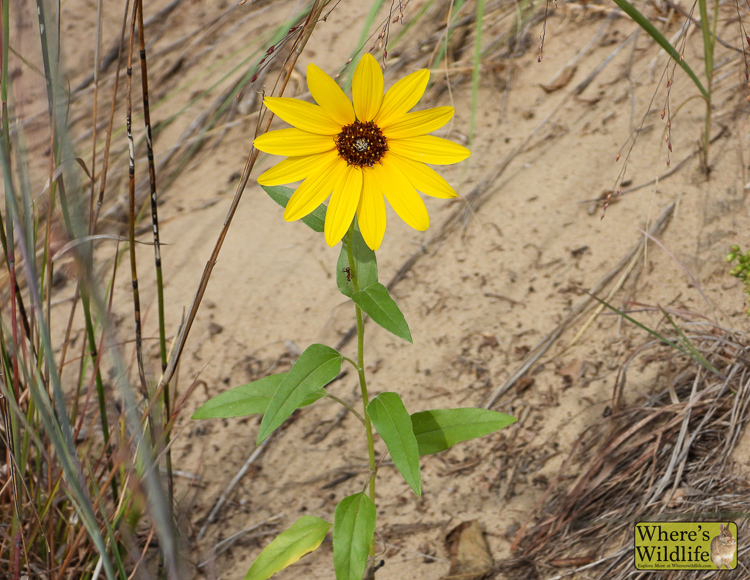
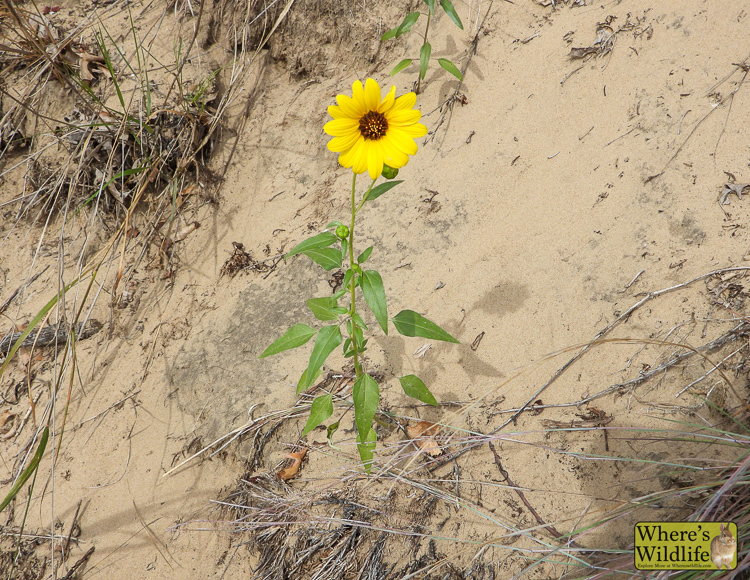
Look for stalked, mostly alternate leaves with three prominent veins and few or no teeth. Yellow rays surround a dark reddish-brown disk. Narrow, pointed bracts overlap beneath the head; whitish hairs on the floral chaff often show near its center.

Where and when to look

Search sandy prairies, roadsides and disturbed open ground from midsummer into fall. It is associated with the Great Plains and has spread eastward; note local habitat and possible planting history when documenting a patch.

Range & sightings

Native to parts of North America, including the United States.

Reported U.S. distribution
AR, AZ, CA, CO, CT, IA, ID, IL, IN, KS, LA, MA, ME, MI, MN, MO, MT, NC, ND, NE, NJ, NM, NV, NY, OH, OK, OR, PA, RI, SC, SD, TN, TX, UT, VA, VT, WA, WI, WV, WY

State records describe documented distribution, not presence in every county. A state record alone does not establish that every population there is native. The observation map shows reported sightings and may include cultivated plants.

Distribution source: USDA PLANTS.

Observations show reported sightings; they do not define the plant’s complete native range.

A closer look

An annual renewed by seed

This sunflower grows from seed and completes its life cycle in one season. A taproot supports the plant, and later generations arise through reseeding. Photograph the same area the next year to compare where new plants appear.

The disk produces the fruits

Fertile disk florets develop into small fruits, while the showy yellow rays are sterile. A close view during bloom and another after the rays fade can connect the flowering disk with the developing seed head.

Observe more than the yellow rays

Bees, wasps and beetles visit for nectar or pollen. Watch where they feed, and photograph the head from the back as well as the front. The narrow bracts may contribute more to a useful identification record than another frontal view of the yellow display.

Compare Annual Sunflower

Helianthus petiolaris

Helianthus annuus

Helianthus annuus generally has broader leaves, broader head bracts and larger heads. Prairie Sunflower’s whitish central chaff is useful, but hybrids can occur where the two grow together. Use leaves, bracts and the disk together.

Keep learning

Study the photographs and field notes for Prairie Sunflower, then practice identifying this and other wildflowers in the quiz.

Share this:

Like this:

Like Loading…