How to recognize it
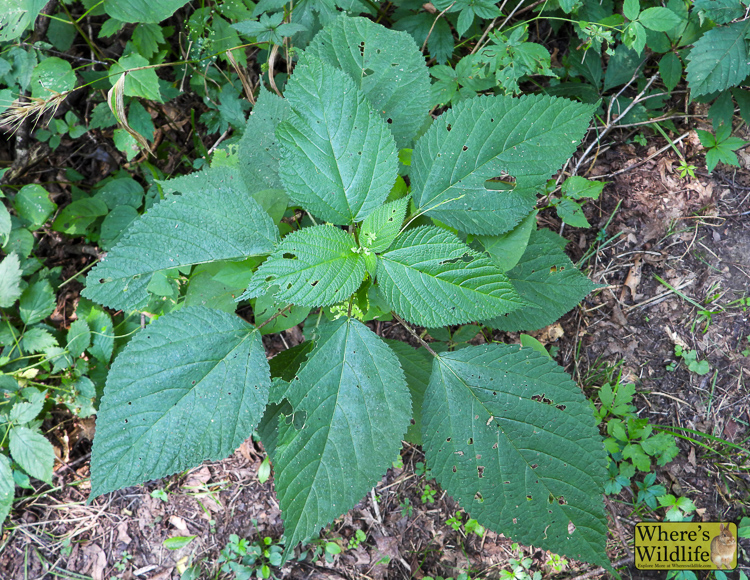
Follow alternate leaves along the stem
The broad leaves attach one at a time, unlike the opposite leaves of Stinging Nettle and False Nettle. Include several nodes so overlapping foliage does not obscure the arrangement.
Family Urticaceae · nettle family
Life cycle Perennial
Blooms July–August (Upper Midwest)
Height 18–40 inches
Light & habitat Part shade, shade; moist woods, floodplains
Common names
Wood Nettle
Bloom timing and mature height vary with location and growing conditions. Sources: Minnesota Wildflowers.
Explore photographed sightings and their locations.
Compare flowers, foliage and the plant in its habitat. Select any photo to enlarge it.
The broad leaves attach one at a time, unlike the opposite leaves of Stinging Nettle and False Nettle. Include several nodes so overlapping foliage does not obscure the arrangement.
Woodland Wildflower
Blooms: July – August
Habitat: Wood Nettle prefers partial sun to medium shade with moist conditions and a fertile loamy soil with abundant organic matter. Look for Wood Nettle in moist floodplain woodlands, moist bottomland woodlands, mesic woodlands, shady seeps, and other moist places in wooded areas.
Native to parts of North America, including the United States.
Reported U.S. distribution
AL, AR, CT, DC, DE, FL, GA, IA, IL, IN, KS, KY, LA, MA, MD, ME, MI, MN, MO, MS, NC, ND, NE, NH, NJ, NY, OH, OK, PA, RI, SC, SD, TN, VA, VT, WI, WV
State records describe documented distribution, not presence in every county. A state record alone does not establish that every population there is native. The observation map shows reported sightings and may include cultivated plants.
Distribution source: USDA PLANTS.
Observations show reported sightings; they do not define the plant’s complete native range.
The tiny green female flowers form branching clusters near the top. They can look more like small leafy structures than familiar flowers; a close-up helps reveal their shape.
Loose male clusters arise from leaf axils farther down the stem. Include both upper and lower clusters in a wider view before photographing individual flowers.
The oval to egg-shaped leaves narrow to pointed tips and have long stalks. Record the full blade, its teeth and the stem attachment rather than relying on one surface detail.
Stinging hairs occur on stems and leaf stalks and can occur on leaf surfaces. Use camera magnification and keep clear of the foliage when recording details.
Study the photographs and field notes for Wood Nettle, then practice identifying this and other wildflowers in the quiz.
Explore wildlife guides, educational posters, and PNG clipart. Use the filters to narrow your results.