WHERE’S WILDLIFE • WILDFLOWER FIELD GUIDE

Small-flowered Water Plantain

Alisma subcordatum
NATIVE • WILDFLOWER

At a glance

Family   Alismataceae
Life cycle   Aquatic perennial
Blooms   June–September
Height   Flowering stalk can reach about 3½ feet
Light & habitat   Full sun; shallow freshwater or wet, organic or silty mud

Common names
Small-flowered Water Plantain · American Water Plantain

Bloom timing and mature height vary with location and growing conditions. Sources: Botanical reference.

Range Map

Explore photographed sightings and their locations.

View photos & full species guideHide photos & full species guide

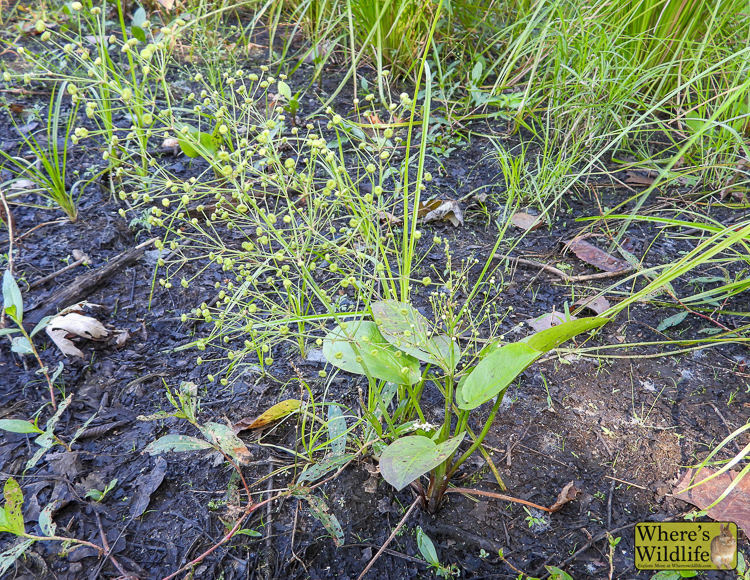
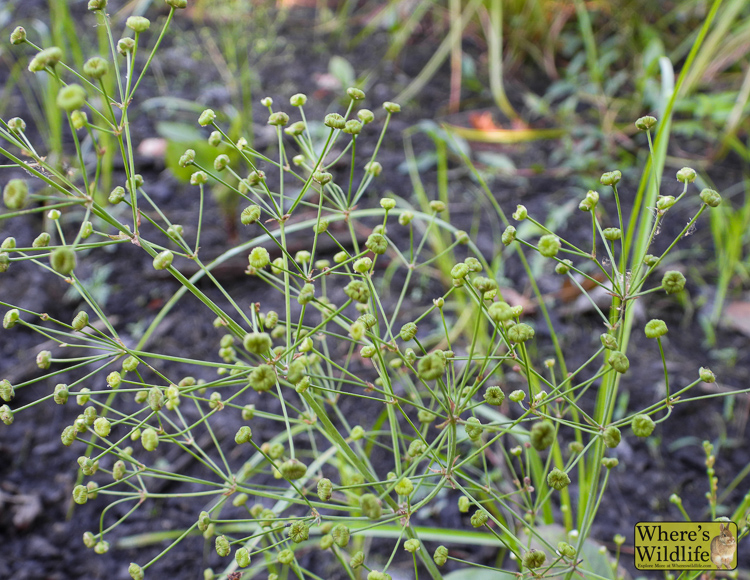
Field photographs

Compare flowers, foliage and the plant in its habitat. Select any photo to enlarge it.

How to recognize it

Follow the branching stalk

Follow a broad leaf down its own stalk to the base. A separate, leafless flowering stalk rises above the leaves. Several fine branches leave the stalk at each tier, giving the whole cluster an open, airy outline.

Where and when to look

Look along sunny pond margins, marshes, ditches, and quiet stream edges. Plants can stand in shallow freshwater or root in mud exposed as the water recedes. Look for open flowers from June through September and for fruit rings later in the season.

Both flowers are enlarged to the same scale. On the left, Small-flowered Water Plantain has petals 1–3 mm long, about the length of its green sepals. On the right, Northern Water Plantain has petals 3.5–6 mm long that extend well past the sepals. For a field comparison, photograph a fully open flower beside a millimeter scale.

Compare Northern Water Plantain

A closer look

A tiny bloom in profile

Each flower has three delicate white petals alternating with three green sepals. From the side, you can see how the sepals cup the base of the flower. From above, look for the small yellow anthers near the center.

Trace the veins of a basal leaf

Trace the main veins from the stalk toward the pointed tip of the blade. Several curve alongside the midrib, and the edge is smooth. Northern Water Plantain has similar leaves, so look for a flower or ripe fruit head to identify the species.

Look for a flat ring of fruits

After the petals fall, each flower forms a single flat ring of tiny, one-seeded fruits called achenes. From above you can see the individual fruits. Seen edge-on, the same head looks like a thin disk. Measure the whole ripe head across. It spans 2–4 mm in Small-flowered Water Plantain, compared with 4.1–7 mm in Northern Water Plantain.

Educational artwork created with AI for Where’s Wildlife. Select an artwork image to enlarge it.

Range & sightings

Native to parts of North America, including the United States.

Reported U.S. distribution
AL, AR, AZ, CA, CO, CT, DC, DE, GA, IA, IL, IN, KS, KY, MA, MD, ME, MI, MN, MO, MS, NC, ND, NE, NH, NJ, NM, NY, OH, OK, OR, PA, RI, SC, SD, TN, TX, VA, VT, WI, WV

State records describe documented distribution, not presence in every county. A state record alone does not establish that every population there is native. The observation map shows reported sightings and may include cultivated plants.

Distribution source: USDA PLANTS.

Observations show reported sightings; they do not define the plant’s complete native range.

Keep learning

Study the photographs and field notes for Small-flowered Water Plantain, then practice identifying this and other wildflowers in the quiz.

Share this:

Like this:

Like Loading…