Family Lamiaceae · mint family Life cycle Perennial Blooms June–September (Upper Midwest) Height 16–30 inches Light & habitat Part shade, shade; moist woods, thickets, floodplains
Common names Hairy Wood Mint · Hairy Pagoda Plant
Bloom timing and mature height vary with location and growing conditions. Sources: Minnesota Wildflowers.
Explore photographed sightings and their locations.
View photos & full species guideHide photos & full species guide
Field photographs
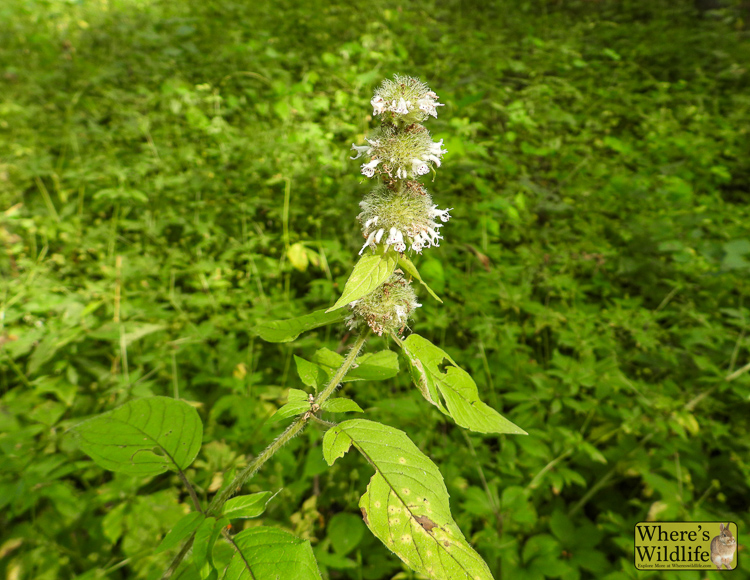
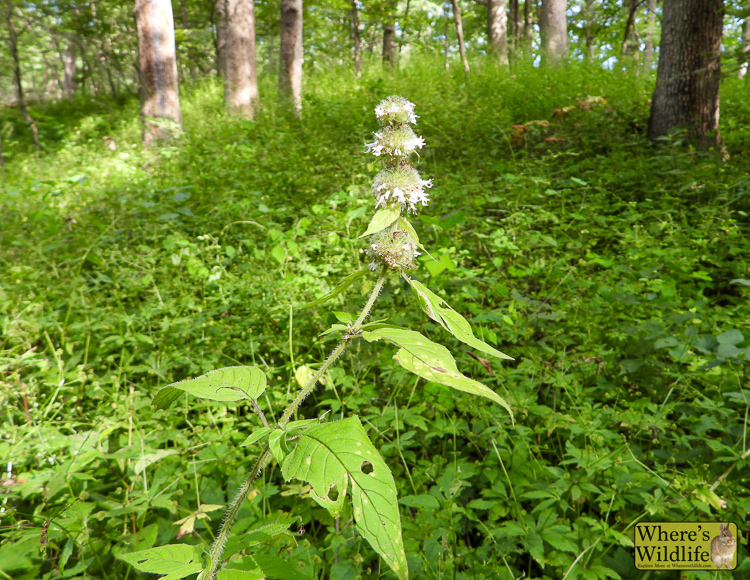
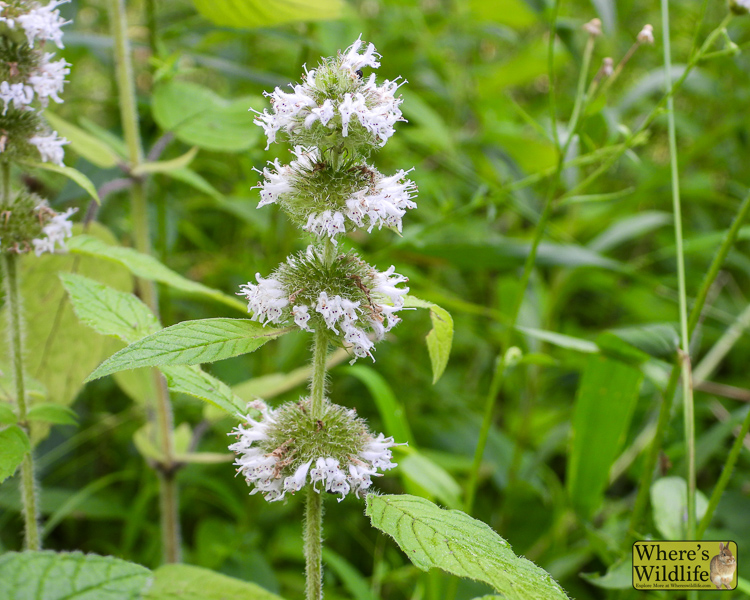
The first two photographs show Hairy Wood Mint at Teason’s Woods in Illinois. Open the third for a close look at the pale blossoms, toothed leaves and spreading stem hairs.
Hairy Wood Mint in flower.
A flowering stem in dappled woodland light.
Hairy Wood Mint’s pale, purple-spotted flowers in tiers along a hairy stem.
How to recognize Hairy Wood Mint
Start with the lowest flower ring. Follow one of the leaves beneath it back to the stem to find its stalk. Then look at the bare stretch between two rings, where the spreading hairs show up against the background.
Hairs at a leaf joint
The enlarged view shows where two leaf stalks join the four-sided stem. Look along an edge of the stem to see how far the hairs extend.
A woodland in summer
Hairy Wood Mint grows in moist deciduous woods, along streams and at woodland edges. In a patch of dappled light, its pale flower rings can stand out above the surrounding greenery.
A ring of spotted flowers
Each tier holds many small, two-lipped flowers. Look for purple speckles on the lower lip and the narrow green points among the blossoms.
Follow the paired leaves
Start low on this flowering stem and work upward. The toothed leaves grow in opposite pairs. Follow a blade inward to see the stalk that connects it to the main stem.
Look between the flower rings
In this closer view of the same field photograph, look along the green stem just below a flower ring. The long, pale hairs stand out on both sides. Select the image to see the full photograph.
At Teason’s Woods
The mint stands where a patch of sunlight reaches the woodland floor. This wider photograph shows the neighboring vegetation and tree trunks around the flowering plant in Palos Hills, Illinois.
The botanical study and woodland scene are AI-generated watercolors based on Brian Woolman’s photographs. Brian took the field photographs and both images in the comparison below.
Hairy Wood Mint or Downy Wood Mint?
Both have pale to lavender flowers in rings. The easiest comparison is at the same spot on each plant, the pair of leaves immediately below the lowest ring of flowers.
Hairy Wood Mint
In Blephilia hirsuta, the leaf stalks at the lowest flower ring are typically 10 mm or longer. The blades have conspicuous teeth. Between rings, look for long, spreading stem hairs.
Downy Wood Mint
In Blephilia ciliata, leaves at that same ring attach directly or on stalks under 5 mm long. The leaf edges are smooth or shallowly toothed, and the short stem hairs usually curve close to the surface.
Another lookalike in damp ground
If the flower rings sit in the leaf axils and the stem ends in a tuft of ordinary leaves, consider Wild Mint. On Hairy Wood Mint, the series of flower rings reaches the stem tip. A photograph that includes the tip helps separate the two.
Range & sightings
Native to eastern Canada and the central and eastern United States.
Reported U.S. distribution AL, AR, CT, DE, GA, IA, IL, IN, KS, KY, MA, MD, MI, MN, MO, NC, NE, NY, OH, PA, TN, VA, VT, WI, WV
State records describe documented distribution, not presence in every county. A state record alone does not establish that every population there is native. The observation map shows reported sightings and may include cultivated plants.