Family: Ranunculaceae · buttercup family Genus:Delphinium Life cycle: Perennial Blooms: Spring, generally April–June Height: Usually 6–18 inches Habitat: Rich woods, ravines and rocky woodland slopes Light: Dappled shade to partial sun
Other common name: Spring Larkspur
Bloom timing and size vary by region and conditions. Larkspurs are toxic if eaten.
Explore photographed sightings and their locations.
View photos & full species guideHide photos & full species guide
Field photographs
Compare flowers, foliage and the plant in its habitat. Select any photo to enlarge it.
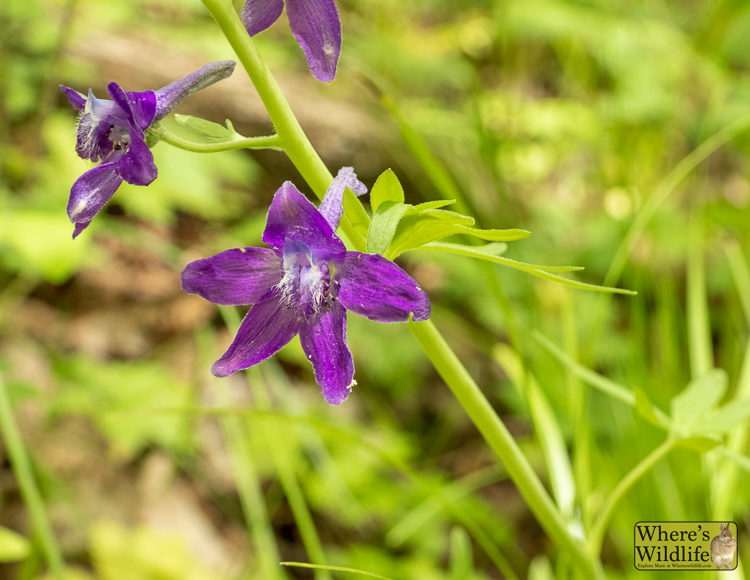
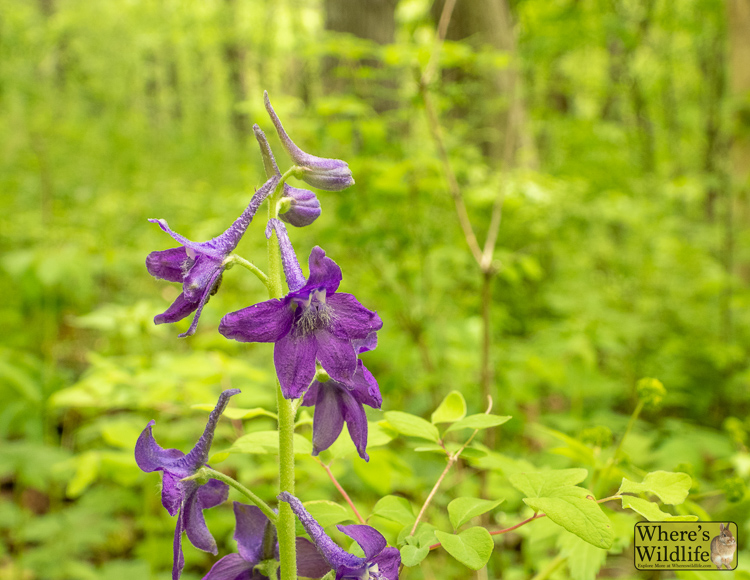
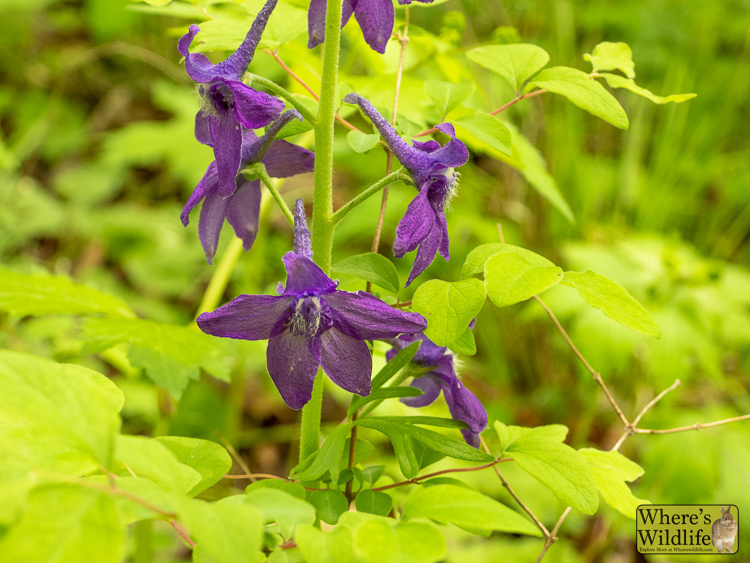
Dwarf Larkspur flowering among woodland foliage.
Dwarf Larkspur’s purple blossoms along an upright green stem.
Dwarf Larkspur’s deep purple flower in close view.
How to recognize it
A spur behind each flower: turn to a side view to see the long projection pointing backward and slightly upward.
Deeply divided leaves: most foliage sits low on the plant, with long stalks and hand-shaped divisions.
A short, loose flower cluster: blossoms are usually blue-violet, though white and mixed-color forms occur.
Use the leaves, stature and flowering season together. Other larkspurs and cultivated varieties can resemble it; flower color alone is not enough.
Botanical artwork showing divided leaves and front and side views of the flower.
Habitat artwork: Dwarf Larkspur on a spring woodland slope.
Where and when to look
Look in spring on wooded slopes, in ravines and along rocky woodland bluffs. Dappled light reaches the forest floor while the canopy is still opening.
Flowering is generally April–June across its range, with local timing shaped by latitude and weather. Plants are usually only 6–18 inches tall, so scan low among the emerging woodland foliage.
The story behind the spur
The large colored parts are five petal-like sepals. The upper one extends backward into a long spur, enclosing the nectar-bearing extensions of the small inner petals.
Long-tongued bees visit the flower entrance to reach nectar. A side view shows why the spur is such a useful identification feature; from the front it can be hidden.
Later, a fertile flower produces three spreading seed pods, the “three horns” reflected in tricorne.
Flower-detail artwork showing the rear spur and a visiting bumblebee.
Range & sightings
Native to parts of North America, including the United States.
Reported U.S. distribution AL, AR, DC, GA, IA, IL, IN, KS, KY, MD, MN, MO, MS, NC, NE, OH, OK, PA, SC, TN, VA, WV
State records describe documented distribution, not presence in every county. A state record alone does not establish that every population there is native. The observation map shows reported sightings and may include cultivated plants.