Family Asteraceae · aster family Life cycle Perennial Blooms May–August (Upper Midwest) Height 8–30 inches Light & habitat Part shade, sun; prairies, meadows, open woods
Explore photographed sightings and their locations.
View photos & full species guideHide photos & full species guide
Field photographs
Compare flowers, foliage and the plant in its habitat. Select any photo to enlarge it.
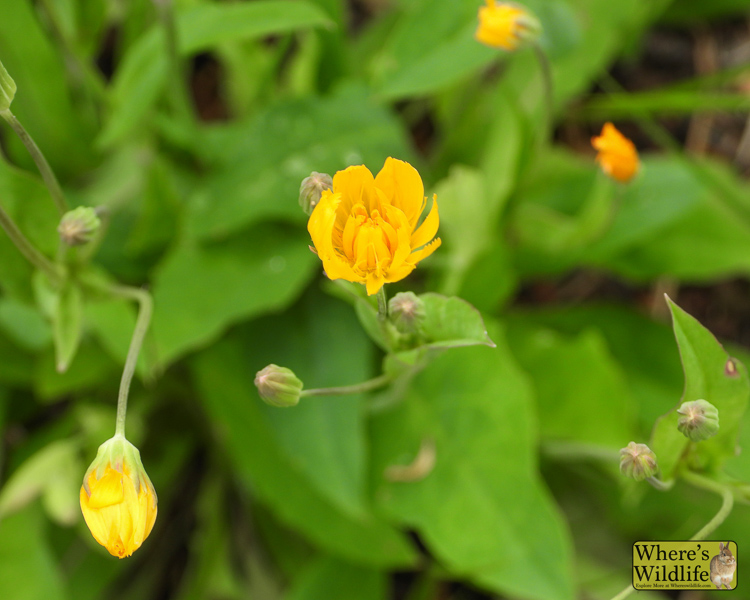
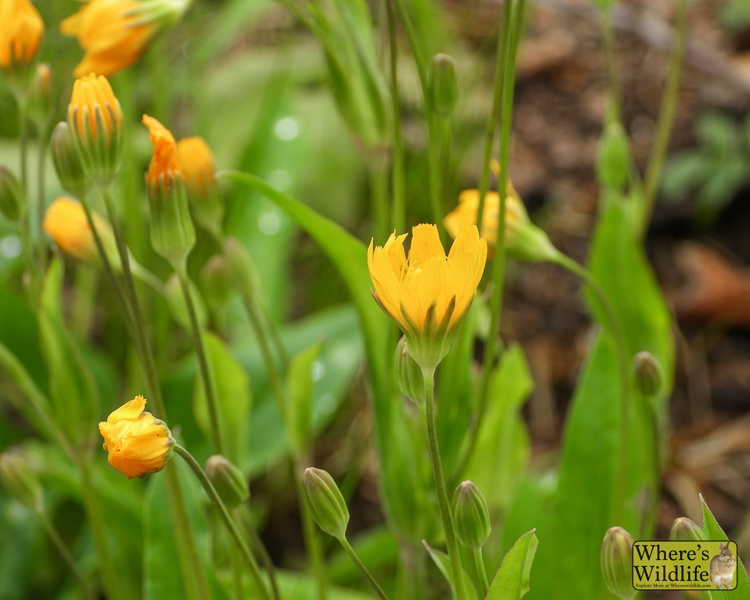
Two-flowered Cynthia’s open yellow flower above two green buds.
Two-flowered Cynthia’s yellow bloom beside a hanging bud.
Two-flowered Cynthia’s yellow flower head beginning to open.
Two-flowered Cynthia’s yellow petals emerging beside green buds.
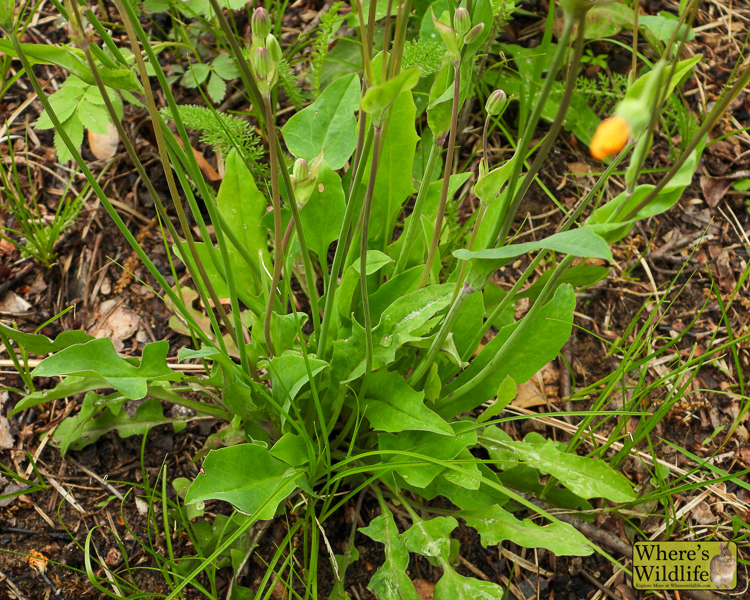
Two-flowered Cynthia’s leafy base beneath slender flower stalks.
How to recognize it
Key identification clues
Look for orange-tinged heads on long stalks and a few small leaves clasping the flowering stem. Basal leaves are broader toward the tip, with narrow, sometimes winged stalks.
Where and when to look
Savanna & Thicket Wildflower Blooms: May – August
Habitat: Two-flowered Cynthia prefers partial or dappled sunlight with mesic to dry conditions. Look for Two-flowered Cynthia in open upland woodlands, open sandy woodlands, savannas and sandy savannas, rocky wooded slopes, thinly wooded bluffs, areas along woodland paths, rocky glades, and upland meadows.
Range & sightings
Native to parts of North America, including the United States.
Reported U.S. distribution AL, AR, AZ, CO, CT, DE, GA, IA, IL, IN, KS, KY, MA, MD, MI, MN, MO, MS, NC, NJ, NM, NY, OH, OK, PA, TN, VA, WI, WV
State records describe documented distribution, not presence in every county. A state record alone does not establish that every population there is native. The observation map shows reported sightings and may include cultivated plants.
Observations show reported sightings; they do not define the plant’s complete native range.
A closer look
Not always exactly two
Several heads can develop, although often only one or two are open together. Count buds and spent heads as well as open ones to understand how the common name relates to the display.
A head of strap-shaped flowers
The head contains many narrow ray flowers, rather than a separate disk center surrounded by rays. A close-up helps reveal that the apparent single flower is a cluster.
Different leaves at different levels
The larger basal leaves can be nearly entire, toothed or lobed. Smaller stem leaves clasp the stalk. Photograph both levels rather than expecting every leaf on the plant to have the same outline.
Check the flowering stem
Do not identify it by a dandelion-like head alone. Include the small clasping leaves where flower stalks arise and the basal foliage. This combination is more useful than orange color by itself.
Study the photographs and field notes for Two-flowered Cynthia, then practice identifying this and other wildflowers in the quiz.
Two-flowered Cynthia clipart
Transparent PNG clipart. Select a design for file specifications, licensing and download details. Purchased files do not include the preview watermark.
Clipart savings: 1–5 files $1.99 each · 6–10 files $1.66 each · 11+ files $1.25 each. Discounts are applied automatically to eligible clipart in the cart.