Family Montiaceae · spring beauty family
Life cycle Perennial
Blooms April–June (Upper Midwest)
Height 3–12 inches
Light & habitat Part shade; moist woods
Common names
Spring Beauty; Virginia Spring Beauty; Narrow-leaved Spring Beauty
Bloom timing and mature height vary with location and growing conditions. Sources: Minnesota Wildflowers · NC State Extension.
Explore photographed sightings and their locations.
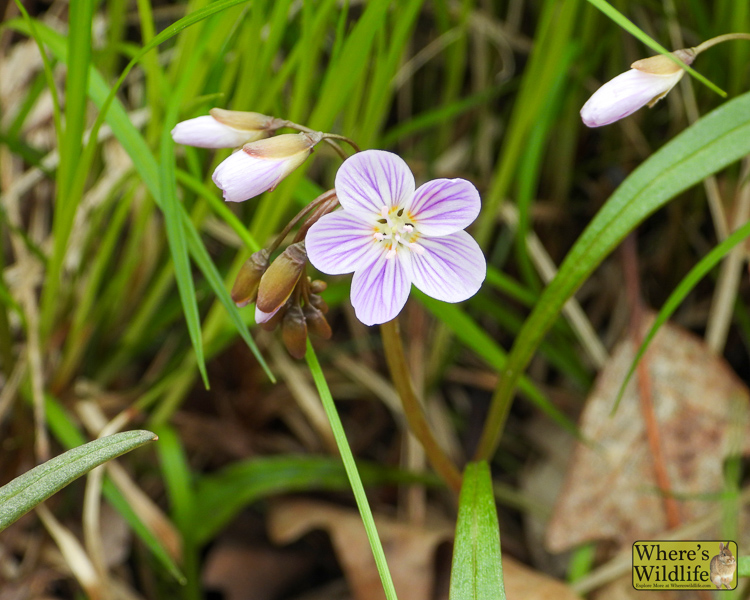
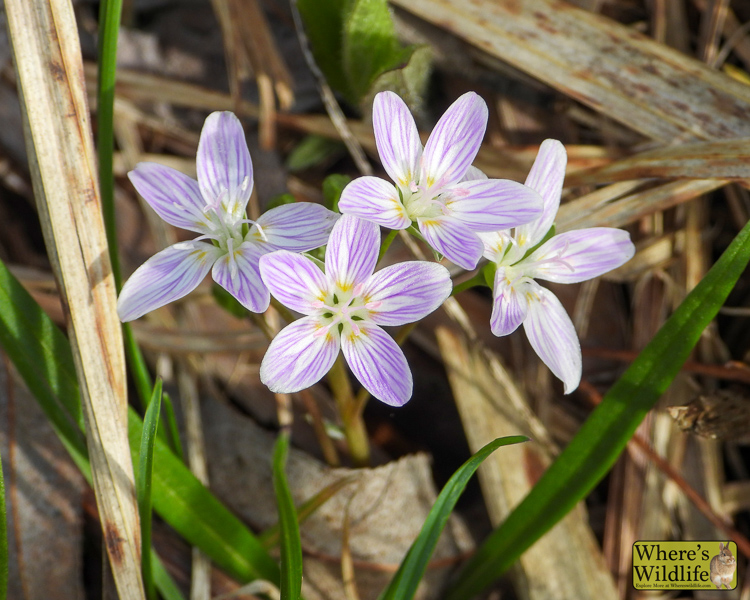
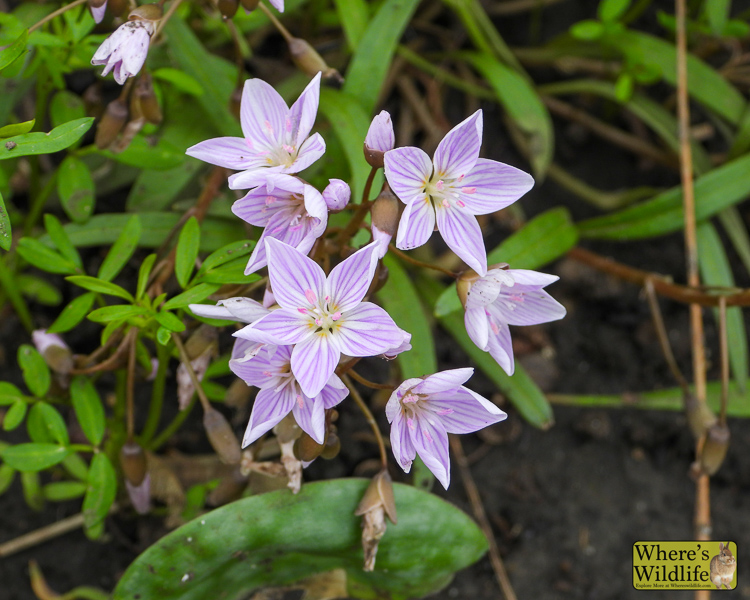
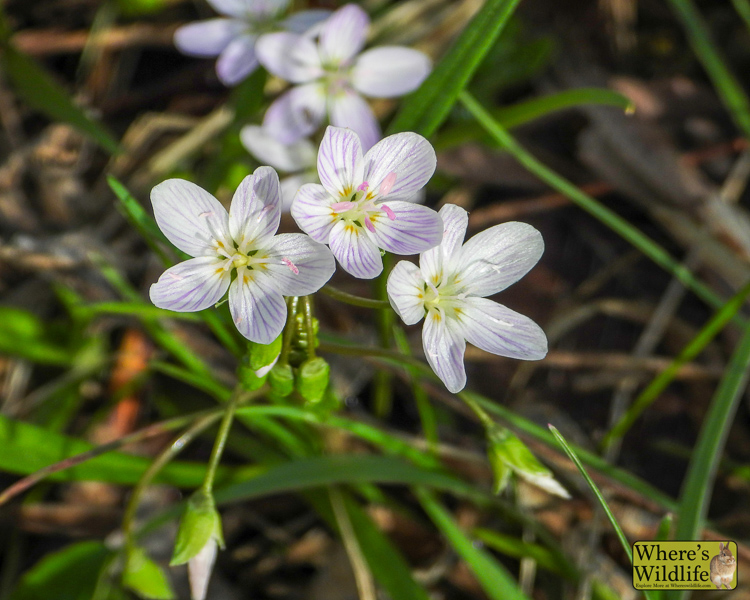
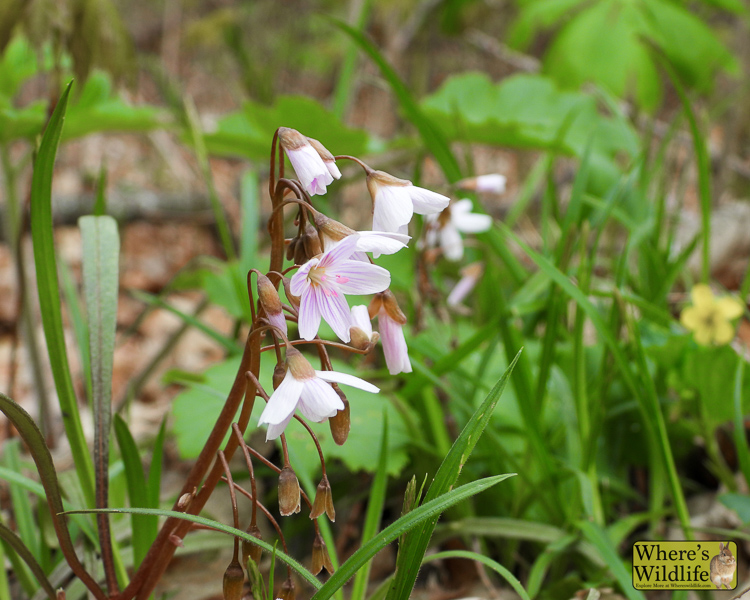
Compare flowers, foliage and the plant in its habitat. Select any photo to enlarge it.
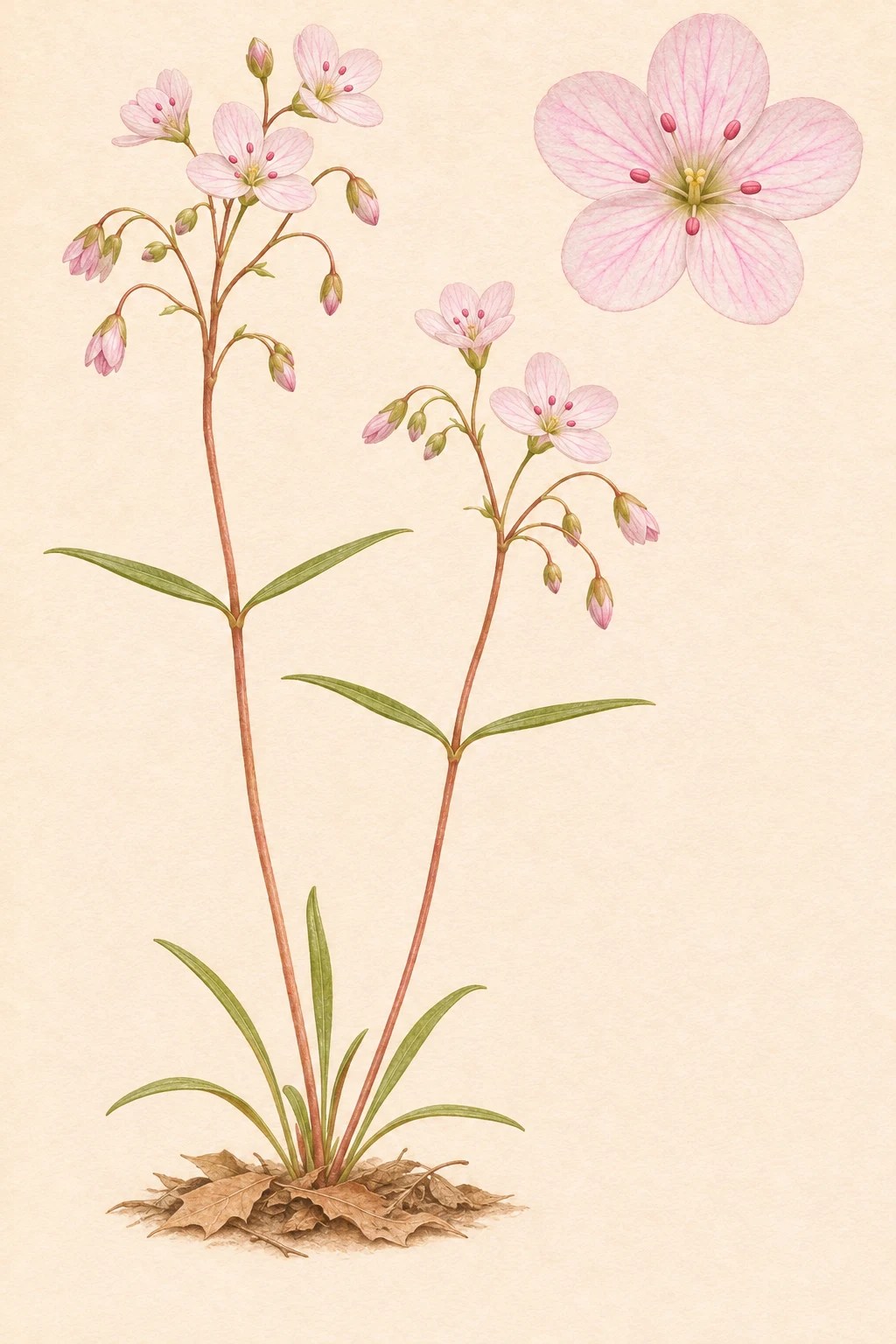
A single pair of long, narrow, smooth-edged leaves sits opposite each other partway up the flowering stem. A few similar leaves may arise near the base. The stems and leaves are hairless.
Carolina Spring Beauty (Claytonia caroliniana) has shorter, broader leaves. Check the complete leaf shape along with the flowers when distinguishing the two.
From April through June in the Upper Midwest, scan moist deciduous woods, woodland edges and open wooded slopes. Plants often grow in rich soil among last year’s fallen leaves.
Look while sunlight still reaches the forest floor through the developing tree canopy. A sunny visit is best for seeing the flowers fully open.
Spring Beauty is a spring ephemeral: its above-ground season is brief. It flowers and fruits early, then its leaves and stems die back as spring gives way to summer.
A small underground storage organ called a corm survives the dormant season. The plant is a perennial and can return the following spring.
Illustration: spring growth at left; summer dormancy at right. The soil is shown cut away to reveal the corm.
Native to parts of North America, including the United States.
Reported U.S. distribution
AL, AR, CT, DC, DE, GA, IA, IL, IN, KS, KY, LA, MA, MD, MI, MN, MO, MS, NC, NE, NJ, NY, OH, OK, PA, RI, SC, TN, TX, VA, VT, WI, WV
State records describe documented distribution, not presence in every county. A state record alone does not establish that every population there is native. The observation map shows reported sightings and may include cultivated plants.
Distribution source: USDA PLANTS.
Observations show reported sightings; they do not define the plant’s complete native range.
Study the photographs and field notes for Spring Beauty, then practice identifying this and other wildflowers in the quiz.
Identification and regional season: Minnesota Wildflowers. Family, flower behavior and dormancy: NC State Extension. Underground corms and ephemeral growth: Chicago Botanic Garden.
Field photographs by Brian Woolman / Where’s Wildlife. Botanical illustrations are educational artwork; compare them with the photographs and multiple identification features.
Explore wildlife guides, educational posters, and PNG clipart. Use the filters to narrow your results.