WHERE’S WILDLIFE • WILDFLOWER FIELD GUIDE

Purple False Foxglove

Agalinis purpurea
NATIVE • WILDFLOWER

At a glance

Family   Orobanchaceae · broomrape family
Life cycle   Annual
Blooms   July–September (Upper Midwest)
Height   1–3 feet
Light & habitat   Sun; along shores, wet meadows, fens

Common names
Purple False Foxglove · Purple Gerardia · Purple Agalinis

Bloom timing and mature height vary with location and growing conditions. Sources: Minnesota Wildflowers.

Range Map

Explore photographed sightings and their locations.

View photos & full species guideHide photos & full species guide

Field photographs

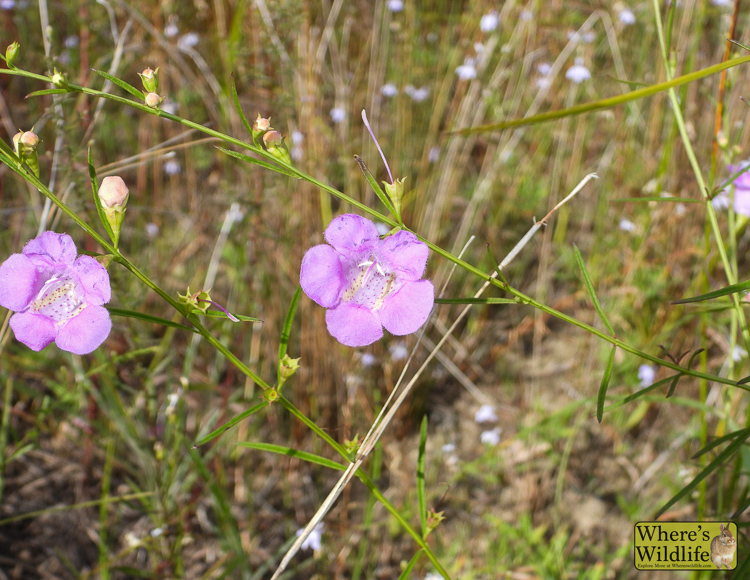
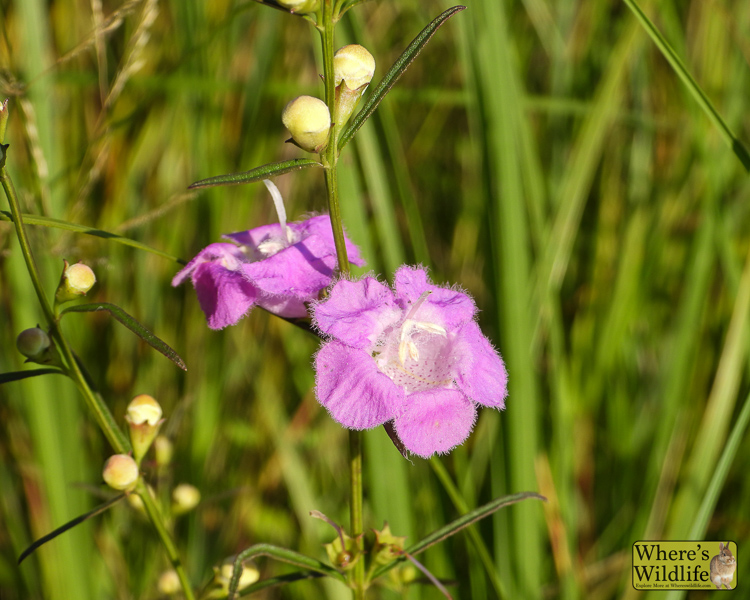
29 field photographs of Purple False Foxglove. Compare flowers, foliage and the plant in its habitat. Select any photo to enlarge it.

Common Buckeye caterpillars on Purple False Foxglove

These four photographs show Common Buckeye caterpillars (Junonia coenia) observed on Purple False Foxglove. Their dark bodies, pale markings, orange patches and branched spines are useful identification clues. Select a photograph to enlarge it.

A butterfly nursery: Purple False Foxglove (Agalinis purpurea) is a documented larval host plant for Common Buckeye butterflies. Its foliage provides food for the caterpillars as they grow, connecting this wildflower to the butterfly’s life cycle. Host-plant reference: Alabama Butterfly Atlas.

How to recognize it

Key identification clues

Look for narrow opposite leaves and short-stalked flowers along the upper branches. The flower tube opens into five lobes with finely hairy edges. Inside are dark purple spots and usually two pale yellow lines. The calyx, the small cup below the flower, has short pointed lobes.

Where and when to look

In the Upper Midwest, look in sunny wet meadows, fens and shore habitats from July through September. Conditions may be seasonally wet rather than flooded when visited. Record the date and soil moisture alongside the photographs.

Two close lookalikes

Purple False Foxglove is on the left. Slender-leaved False Foxglove is on the right. Follow each flower stalk from the leaf joint to the green cup at the base of the bloom. On Purple, the stalk is usually shorter than or about as long as the cup. On Slender-leaved, it extends well beyond the length of the cup.

Small-flower False Foxglove (Agalinis paupercula) also resembles Purple. To separate those two, compare the size of open flowers and the length of the calyx teeth.

A closer look

Photograph the calyx

Turn the flower sideways to see the short stalk and the green cup, called the calyx. In Purple False Foxglove, the stalk is typically 2–5 mm long. The five pointed teeth at the rim are much shorter than the cup itself. A side-view photograph records both features.

A partially parasitic plant

This plant is hemiparasitic: it makes food through photosynthesis while obtaining part of its nourishment through connections to other plants. Those belowground associations are not fully characterized for every population. The visible green shoot is therefore only part of its biology; leave surrounding roots undisturbed.

An annual’s seed capsules

After flowering, look along the same stems for smooth, nearly round capsules about 4–6 mm across. The green cup stays at the base, and its short teeth are still visible around the fruit. Each capsule holds many tiny seeds that can give rise to the next generation of this annual.

Educational artwork created with AI for Where’s Wildlife. Select an artwork image to enlarge it.

Range & sightings

Native to parts of North America, including the United States.

Reported U.S. distribution
AL, AR, CT, DC, DE, FL, GA, IA, IL, IN, KS, KY, LA, MA, MD, MI, MN, MO, MS, NC, NE, NH, NJ, NY, OH, PA, RI, SC, TN, TX, VA, WI, WV

State records describe documented distribution, not presence in every county. A state record alone does not establish that every population there is native. The observation map shows reported sightings and may include cultivated plants.

Distribution source: USDA PLANTS.

Observations show reported sightings; they do not define the plant’s complete native range.

Keep learning

Study the photographs and field notes for Purple False Foxglove, then practice identifying this and other wildflowers in the quiz.

Share this:

Like this:

Like Loading…