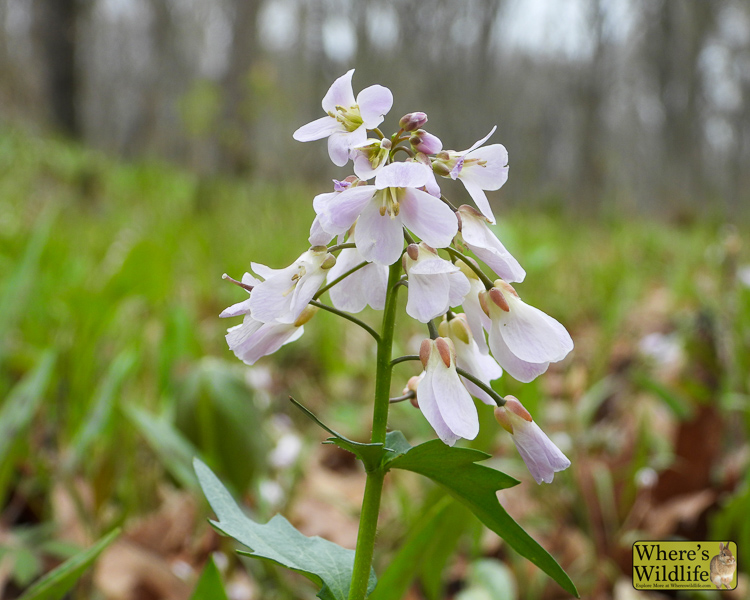
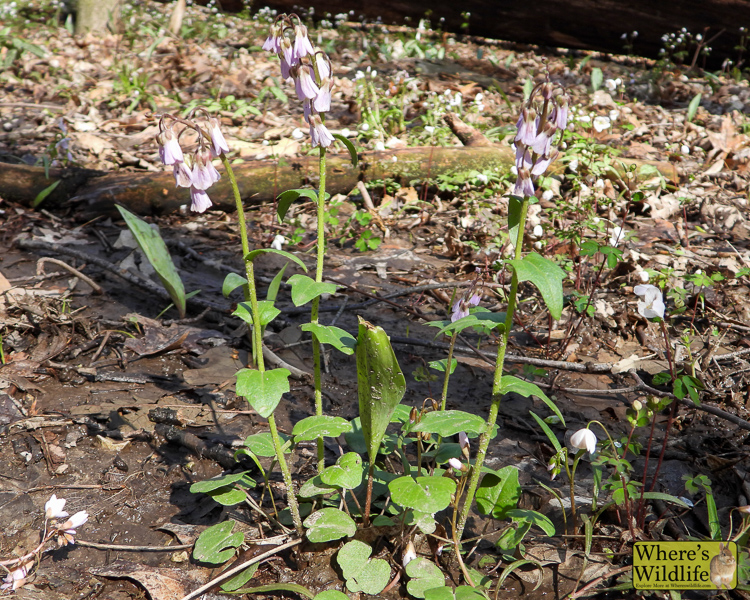
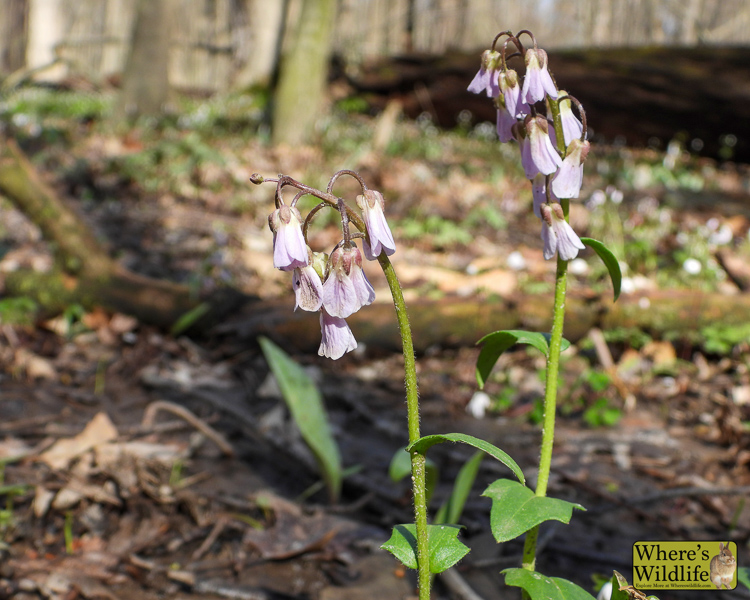
Purple Cress’s pale purple flowers among fresh woodland greenery.
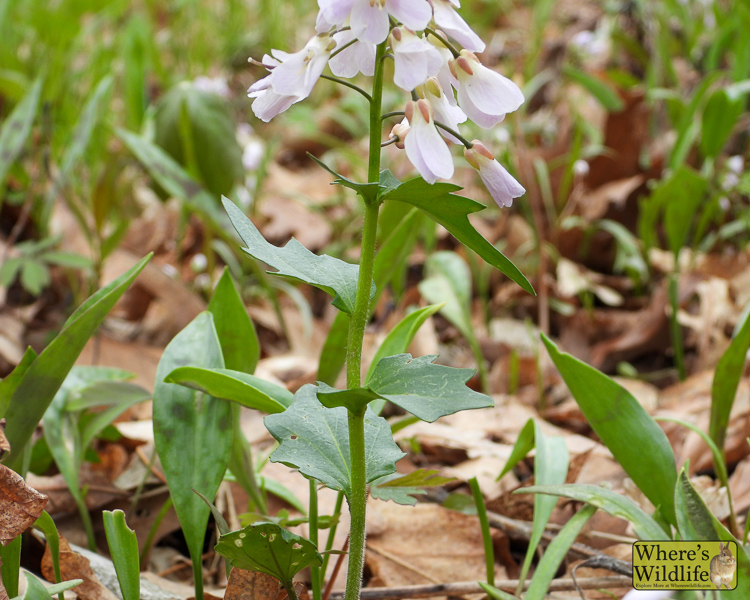
Purple Cress flowering on the woodland floor.
Purple Cress’s hanging buds beside a fallen log.
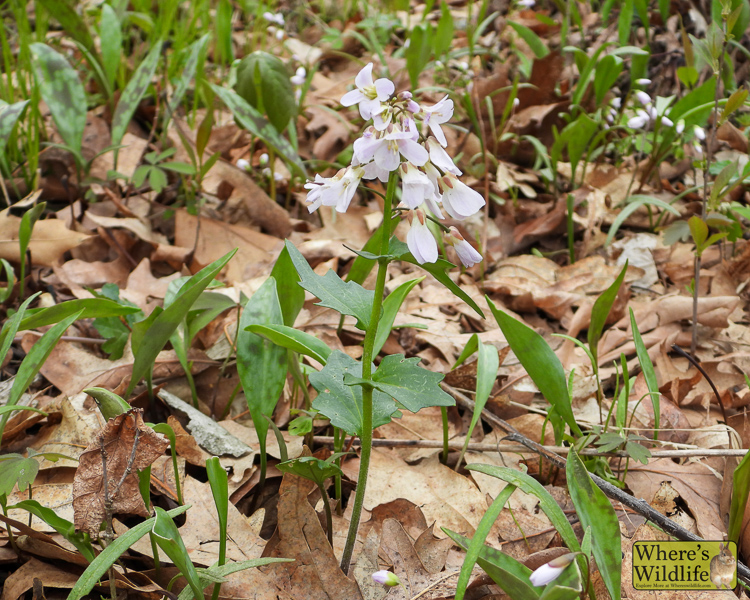
Purple Cress’s pale purple flowers above upright green stems.
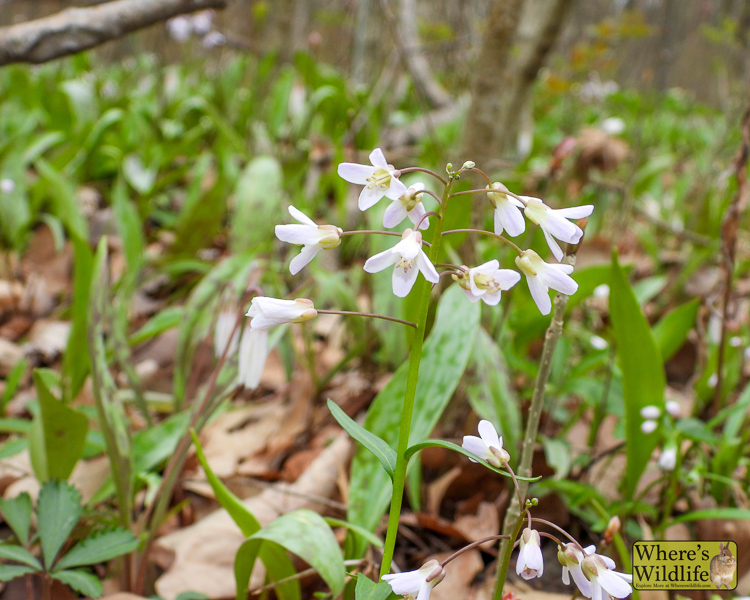
Purple Cress’s drooping buds along an upright stalk.
How to recognize Purple Cress
Look at the upper main stem just below the flower cluster. Short, spreading hairs are a useful clue. Turn a blossom sideways to check for purple on the sepals, the four small parts cupping the base of the petals.
Look beneath the petals
The botanical illustration pairs a flowering shoot with a side view of a blossom. The petals may be only faintly pink, while the sepals directly behind them often show a deeper purple tint.
Spring on the woodland floor
Look for scattered flowering stems among damp leaves in rich deciduous woods and bottomland forests in early spring. The habitat illustration shows how small the pale flower clusters appear against the leaf litter.
Four pale petals
The open flower at the top shows four petals arranged in a cross. The side-facing blossoms below it give a better view of the darker sepals.
The flower from the side
From this angle the petals hang beyond the short sepals. For an identification photograph, include the upper main stem beneath the flower cluster so its surface can be checked at full size.
Follow a leaf to the stem
Follow one of the broad leaves back to the upright stem. The blade is undivided, with a shallowly toothed or wavy edge.
The whole flowering plant
A few simple leaves are spaced up each slender stem, with the blossoms gathered near the tip. The plants can stand well apart even in a small patch.
Purple Cress or Spring Cress?
Both can have nearly white flowers. Start just below the flower cluster: look along the edge of the upper main stem for short, spreading hairs. A hand lens helps. Then check the sepals behind an open flower.
Purple Cress
The upper main stem usually has short hairs that project outward. Sepals often carry a purple tint. The petals can be pink, lavender or nearly white.
Spring Cress
The upper main stem is usually smooth. Look for white petals with pale green sepals behind them. Both cresses have simple, undivided leaves. Open the Spring Cress guide.
From a flower cluster to a row of pods
As the flowers fade, the short cluster lengthens. Slender seed pods develop along the stalk where the blossoms stood.
Range & sightings
Native to parts of North America, including the United States.
Reported U.S. distribution AL, AR, CT, DC, IA, IL, IN, KY, MA, MD, MI, MN, MO, NC, NH, NJ, NY, OH, PA, TN, VA, WI, WV
State records describe documented distribution, not presence in every county. A state record alone does not establish that every population there is native. The observation map shows reported sightings and may include cultivated plants.