
How to recognize it
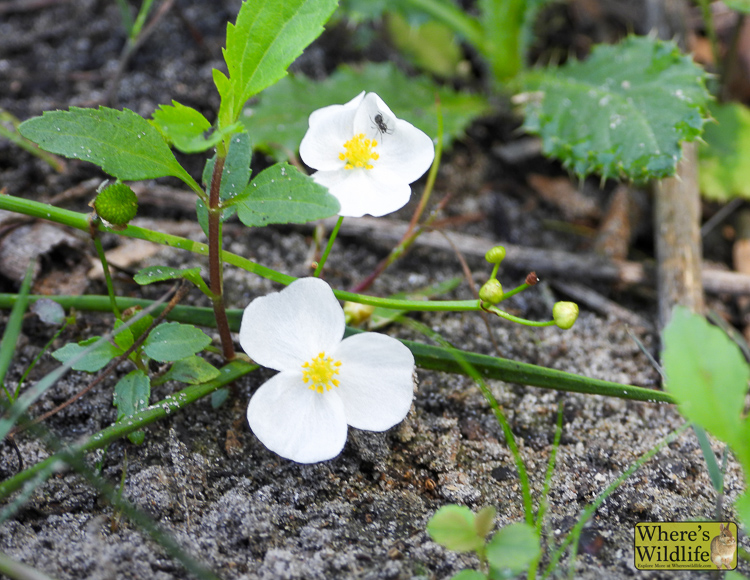
Three white petals above the water
Flowers occur in spaced whorls along an upright stalk. Each has three white petals and three green sepals. Photograph a whole cluster before moving closer to individual flowers.


Family Alismataceae
Life cycle Aquatic perennial
Blooms May–September
Height 1.5–2 feet
Light & habitat Full sun; wetland margins or shallow water
Common names
Grassy Arrowhead · Grass-leaved Arrowhead · Narrow-leaved Arrowhead
Bloom timing and mature height vary with location and growing conditions. Sources: Botanical reference.
Explore photographed sightings and their locations.
Compare flowers, foliage and the plant in its habitat. Select any photo to enlarge it.

Flowers occur in spaced whorls along an upright stalk. Each has three white petals and three green sepals. Photograph a whole cluster before moving closer to individual flowers.
Wetland Wildflower
Blooms: April – November
Habitat: Grassy Arrowhead prefers full to partial sun and wet conditions. Look for Grassy Arrowhead in shallow water or mud in ditches, marshes, streams, lakes, and ponds.
Native to parts of North America, including the United States.
Reported U.S. distribution
AL, AR, AZ, CO, CT, DC, DE, FL, GA, IA, IL, IN, KS, KY, LA, MA, MD, ME, MI, MN, MO, MS, NC, NE, NH, NJ, NM, NY, OH, OK, PA, RI, SC, SD, TN, TX, VA, VT, WA, WI, WV
State records describe documented distribution, not presence in every county. A state record alone does not establish that every population there is native. The observation map shows reported sightings and may include cultivated plants.
Distribution source: USDA PLANTS.
Observations show reported sightings; they do not define the plant’s complete native range.
Male flowers carry numerous stamens; female flowers have a rounded cluster of pistils. Female flowers occupy the lower whorls. Record both types when they are present on a flowering stalk.
Small bracts surround the joints where flower stalks arise. Include these, the stalk lengths, and the sepals in close photographs; an attractive flower portrait alone may omit the features needed for comparison.
Submerged leaves can be ribbon-like, while emergent leaves have more developed blades. Include the water level and leaf bases in a wider view to document the plant’s aquatic growth form.
Several arrowheads have narrow or unlobed leaves. Grassy Arrowhead can also be difficult to separate from Sagittaria platyphylla; careful examination of bracts, flower stalks, and fruits may be needed.
Study the photographs and field notes for Grassy Arrowhead, then practice identifying this and other wildflowers in the quiz.
Explore wildlife guides, educational posters, and PNG clipart. Use the filters to narrow your results.