Cancer Root field photograph. Tap the photo to enlarge.
NATIVE • WILDFLOWER
At a glance
Family Orobanchaceae · broomrape family Life cycle Perennial; parasitic on tree roots Blooms May–June (Upper Midwest) Height Usually 3–8 inches Habitat Oak woods, wooded slopes, ravines and savannas; well-drained soil
Common names Cancer Root · American Cancer-root · Bear Corn · Bumeh · Cancer Corn
Bloom timing and height vary with location. A living host root matters more than sunlight: this plant does not photosynthesize.
Explore photographed sightings and their locations.
Field photographs
Explore 14 field photographs of fresh flowers, developing capsules and old stalks. Select a photo to enlarge it and move through the gallery.
Field photographs: Brian Woolman / Where’s Wildlife.
How to recognize it
A cone-shaped flowering spike
Look for short, thick, unbranched spikes with cream or yellowish flowers packed among pointed scales. There are no broad green leaves; older spikes turn brown and can resemble fallen conifer cones.
Flowers, scales and capsules. Watercolor teaching illustration.
Where and when to look
In May and June, scan the leaf litter in oak woods, on wooded slopes and in ravines. The small cream-colored spikes can be easy to miss beside fallen leaves. Older brown stalks may remain long after flowering.
Look near living oaks. Habitat watercolor.
Look for flowers among the scales
Those pale projections are individual flowers, each with a tube and two lips. The upper lip arches over the opening like a little hood. Look for the brown scale beneath each flower.
A closer look at the flowers in a field photograph.
A closer look
A connection to an oak
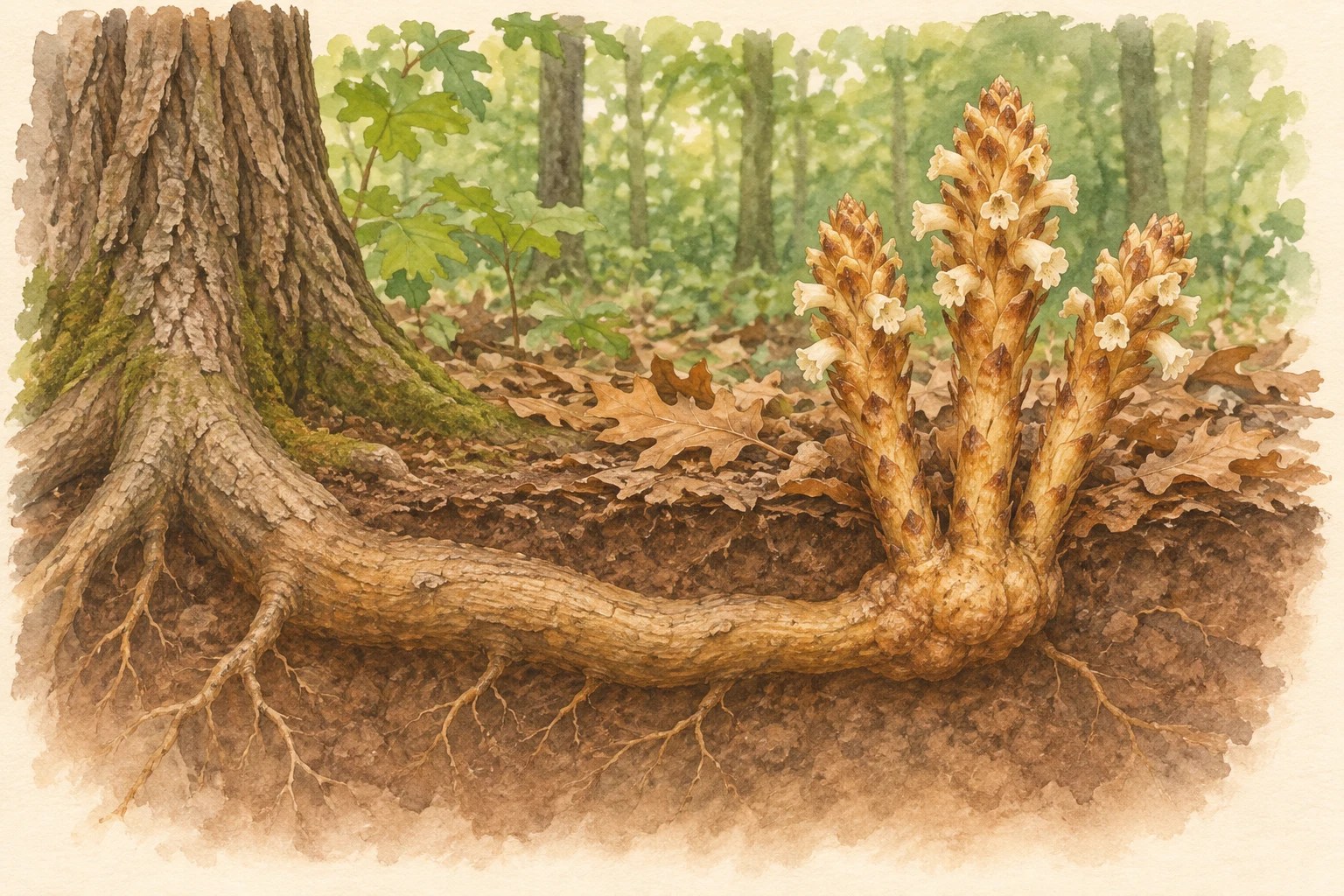
How can a plant live without green leaves? Cancer Root has no chlorophyll. An underground attachment called a haustorium connects it to a living oak root, drawing water, minerals and sugars from its host. The oak makes those sugars using sunlight.
The hidden connection to an oak. Simplified illustration, not to scale.
Flowers open from bottom to top
The lower flowers open before those higher on the spike. Several stages may be visible together, allowing a close photograph to record the progression without disturbing the plant.
Fresh flowers and older portions can occur together.
Brown stalks tell a seasonal story
After flowering, capsules develop with many tiny seeds, and the visible stalk dries. The perennial underground system can produce fresh spikes in later years.
Old stalks remain after the flowering display ends.
Range & sightings
Native to parts of North America, including the United States.
Reported U.S. distribution AL, CT, DC, DE, FL, GA, IA, IL, IN, KY, MA, MD, ME, MI, MS, NC, NH, NJ, NY, OH, PA, RI, SC, TN, VA, VT, WI, WV
State records describe documented distribution, not presence in every county. A state record alone does not establish that every population there is native. The observation map shows reported sightings and may include cultivated plants.