Explore photographed sightings and their locations.
View photos & full species guideHide photos & full species guide
Field photographs
Compare flowers, foliage and the plant in its habitat. Select any photo to enlarge it.
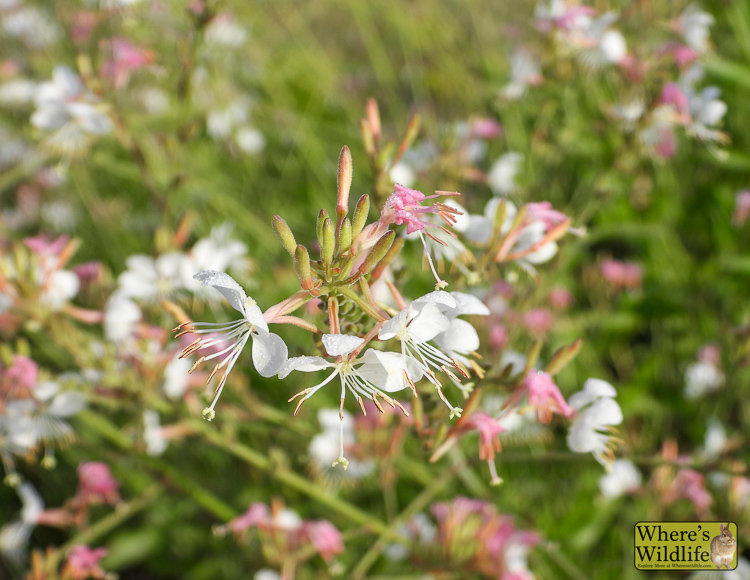
Biennial Gaura’s white petals and long stamens in close view.
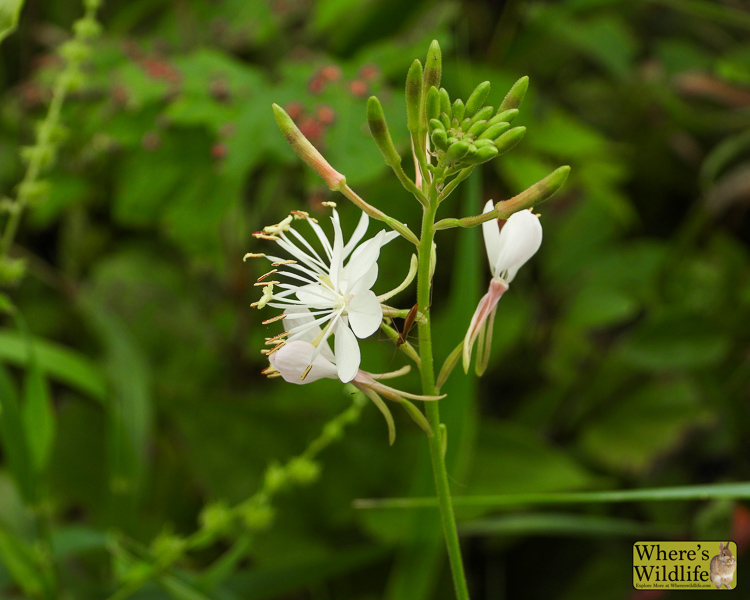
Biennial Gaura’s pale flowers on a slender stem among grasses.
Biennial Gaura’s white flowers and pink buds in a dense flowering patch.
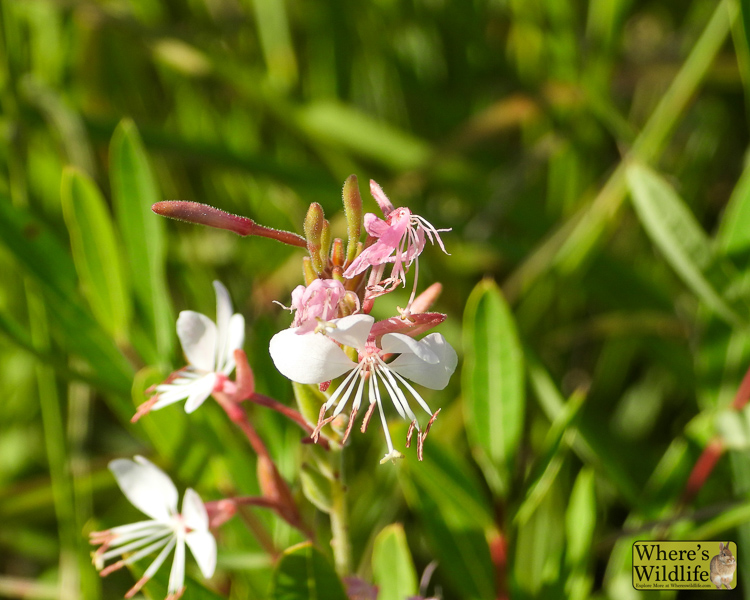
Biennial Gaura’s white and pink flowers with long projecting stamens.
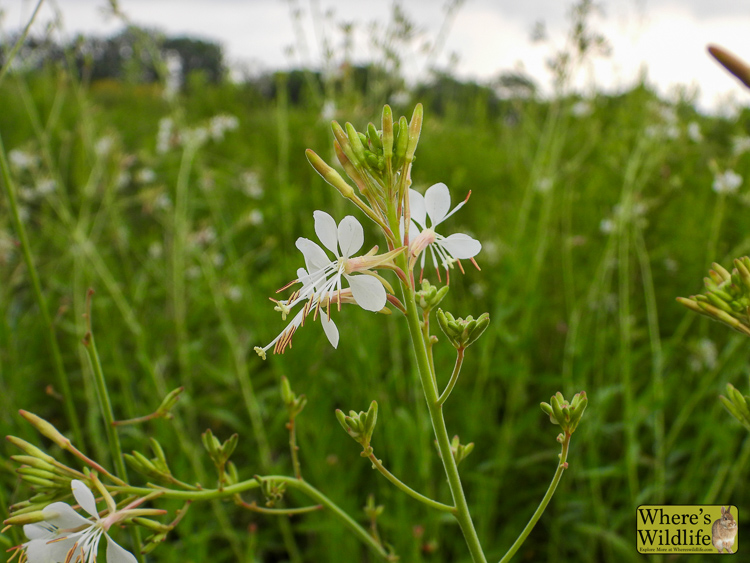
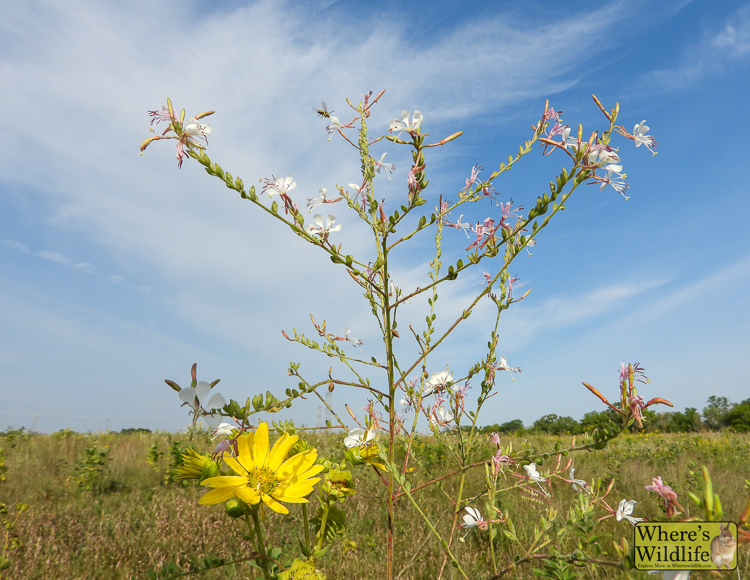
Biennial Gaura’s branching flowering stems against a clouded sky.
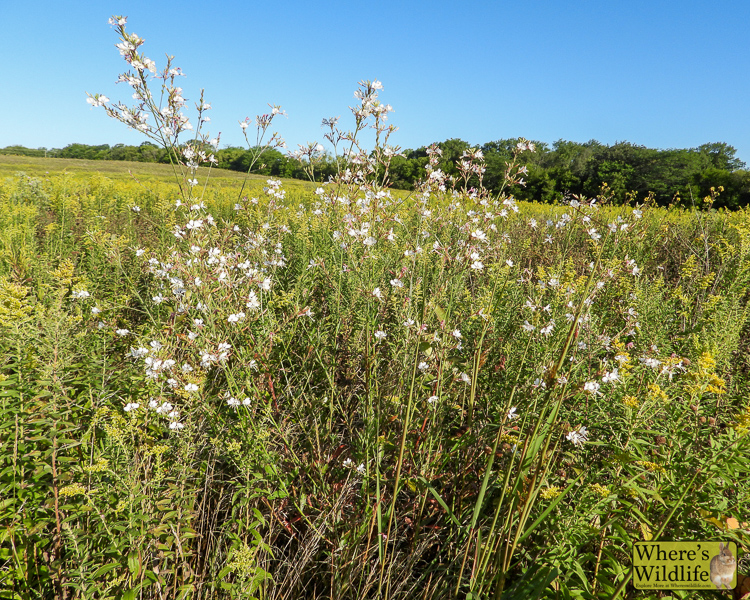
Biennial Gaura’s airy white flower sprays across an open meadow.
Biennial Gaura’s narrow leaves along a reddish branching stem.
A broad patch of Biennial Gaura blooming in tall grass.
Biennial Gaura’s white flower and pink buds against blue sky.
Biennial Gaura’s delicate white blossom above an open field.
How to recognize it
Key identification clues
Look for a tall, branching plant with narrow alternate leaves and spreading stem hairs. Flowers have four petals grouped above eight projecting stamens, creating an uneven rather than circular outline.
Where and when to look
Search sunny prairies, fields, roadside banks and other open disturbed ground from midsummer into autumn. Reduced competition helps this biennial establish.
Range & sightings
Native to parts of North America, including the United States.
Reported U.S. distribution AL, CT, DC, DE, GA, IA, IL, IN, KY, MA, MD, MI, MN, MS, NC, NJ, NY, OH, PA, SC, TN, VA, WI, WV
State records describe documented distribution, not presence in every county. A state record alone does not establish that every population there is native. The observation map shows reported sightings and may include cultivated plants.
Distribution source: USDA PLANTS. USDA lists this plant as Oenothera gaura W.L. Wagner & Hoch.
Observations show reported sightings; they do not define the plant’s complete native range.
A closer look
A two-year sequence
The first year produces a basal rosette; the second brings the tall flowering stem. Photograph the same location across seasons and compare plant stages. A single summer visit may overlook the rosettes that will contribute to the following year’s display.
Read a flowering spike
Flowers open progressively upward, leaving developing capsules below and buds above. The capsules are spindle-shaped and slightly four-ribbed. Record these three stages on one branch to show how a sparse-looking spike can produce flowers over an extended period.
Connections with bees and moths
Long-tongued bees and nectar-seeking moths visit the flowers. Some moth larvae feed on flowers or developing capsules. Look carefully around the blossoms without handling them, and photograph any insects in place; a flower patch supports more than its most conspicuous daytime visitors.
Compare Large-flowered Gaura
Large-flowered Gaura has short hairs pressed against its stems, unlike Biennial Gaura’s spreading hairs. Include stem close-ups and a side view of the flowers when documenting a possible identification.