
Where’s Wildlife · Bird Field Guide
Yellow-billed Cuckoo
Coccyzus americanus
Pronounced (approx.): KOK-sih-zus uh-mair-ih-KAY-nus
A slender, long-tailed bird that often stays concealed among leafy branches.
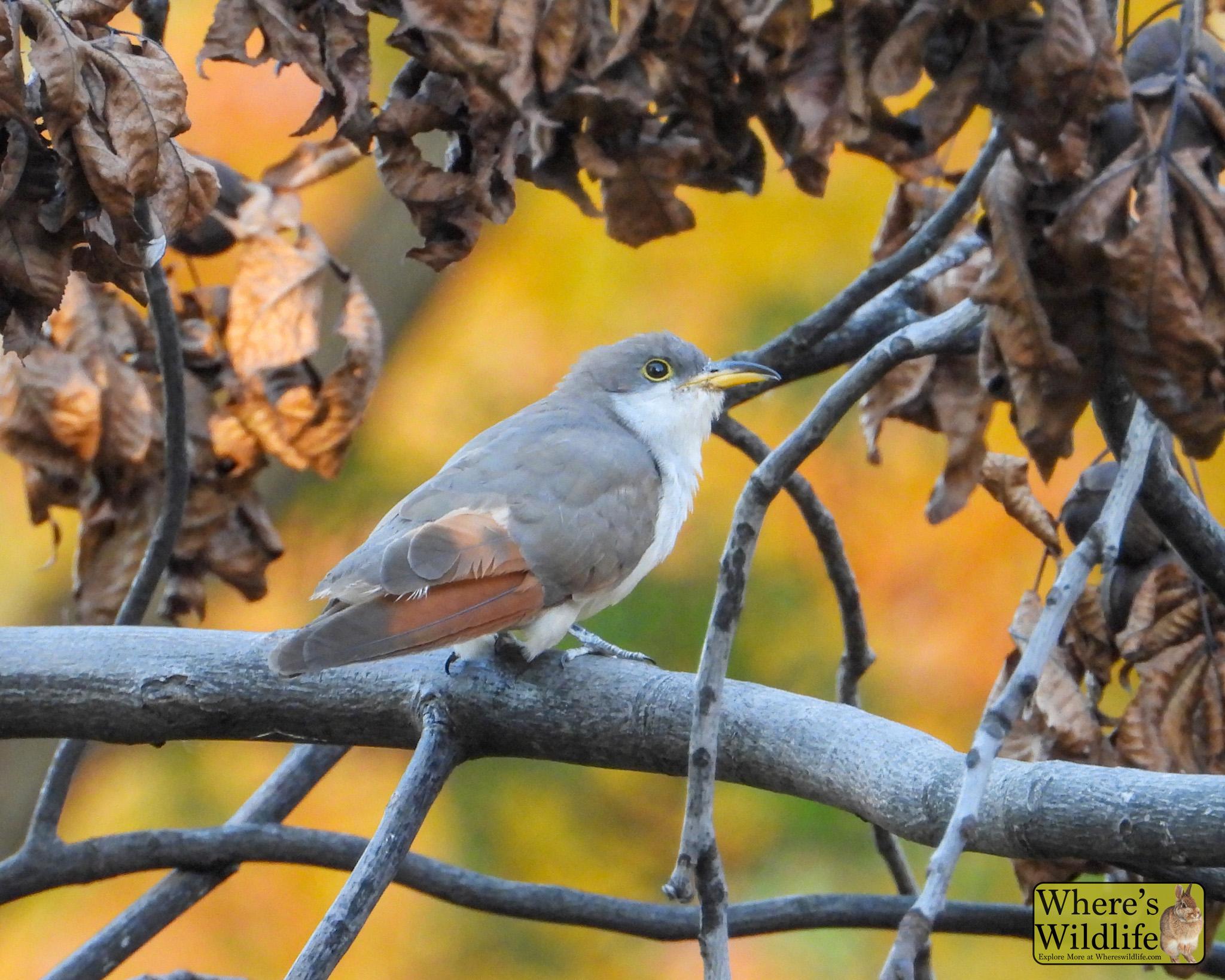
Three Identification Clues
A slim brown-backed bird with white underparts and a very long tail.
Adults have a curved bill with yellow on the lower mandible and rusty patches in the wings.
Large white spots on the dark underside of the tail are especially useful.
Field Photographs
Showing all 3 photographs.


Beyond the first impression
Plumage & Identification
Watch for the underside of the tail
Warm brown upperparts can disappear among leaves, but the large white tail spots may stand out from below. The long, slim body, gently curved bill, and rusty flashes in the wings strengthen the identification when a bird changes position or flies across an opening. [1]
A quiet bird can be surprisingly hidden
A cuckoo may remain still for long periods while searching foliage. Young birds are duller than adults and can have an entirely dark bill at first. Do not turn one missing adult feature into a firm identification of Black-billed Cuckoo. [1]
Life history
How This Bird Lives
Where to look
Search leafy deciduous woodland with gaps and edges, including trees beside streams. In western landscapes, river corridors provide especially important habitat. A glimpse across a clearing may reveal a bird that was almost invisible while perched inside the canopy. [1]
Food & foraging
Caterpillars are important prey, including hairy kinds that many birds avoid. Cuckoos also take cicadas, beetles, and other insects, and sometimes fruit or small vertebrates. Their slow approach lets them inspect leaves and branches carefully before taking a meal. [2]
A rapidly developing family
Both parents build a loose platform of twigs on a branch or in a fork, sometimes adding bark or leaves. The clutch contains 1–5 eggs, with incubation lasting about 9–11 days. [2]
Chicks develop remarkably quickly and can leave the nest within about a week of hatching. Leaving the nest does not mean parental care is over. Please watch from a distance rather than approaching to inspect a young bird. [3]
Did you know?
A Closer Look at Yellow-billed Cuckoos
Different ages in one nest
Egg laying can be spread over several days. An older chick may be nearly ready to leave while a younger sibling is only hatching, creating a striking size difference within one brood. [3]
Not always their own nursery
These cuckoos normally care for their own young, but sometimes lay eggs in another bird's nest. Compare this occasional behavior with the nesting strategy in our Cowbird guide. [3]
The rain crow nickname
Cuckoos sometimes answer loud sounds, including thunder, with their croaking calls. That association helped produce the nickname rain crow; it is not a guarantee that a calling bird predicts rain. [3]
Sources: [1] Cornell · Identification [2] Cornell · Life history [3] Cornell · Species overview
Range & Sightings
Seasonal Range
View Range Map ↗Recorded Observations
Observation records are not a complete seasonal range map.
iNaturalist observation map ↗