
Where’s Wildlife · Bird Field Guide
White-throated Sparrow
Zonotrichia albicollis
Pronounced (approx.): zoh-noh-TRIK-ee-uh al-bih-KOL-iss
A woodland sparrow with a distinct white throat and a whistled song.
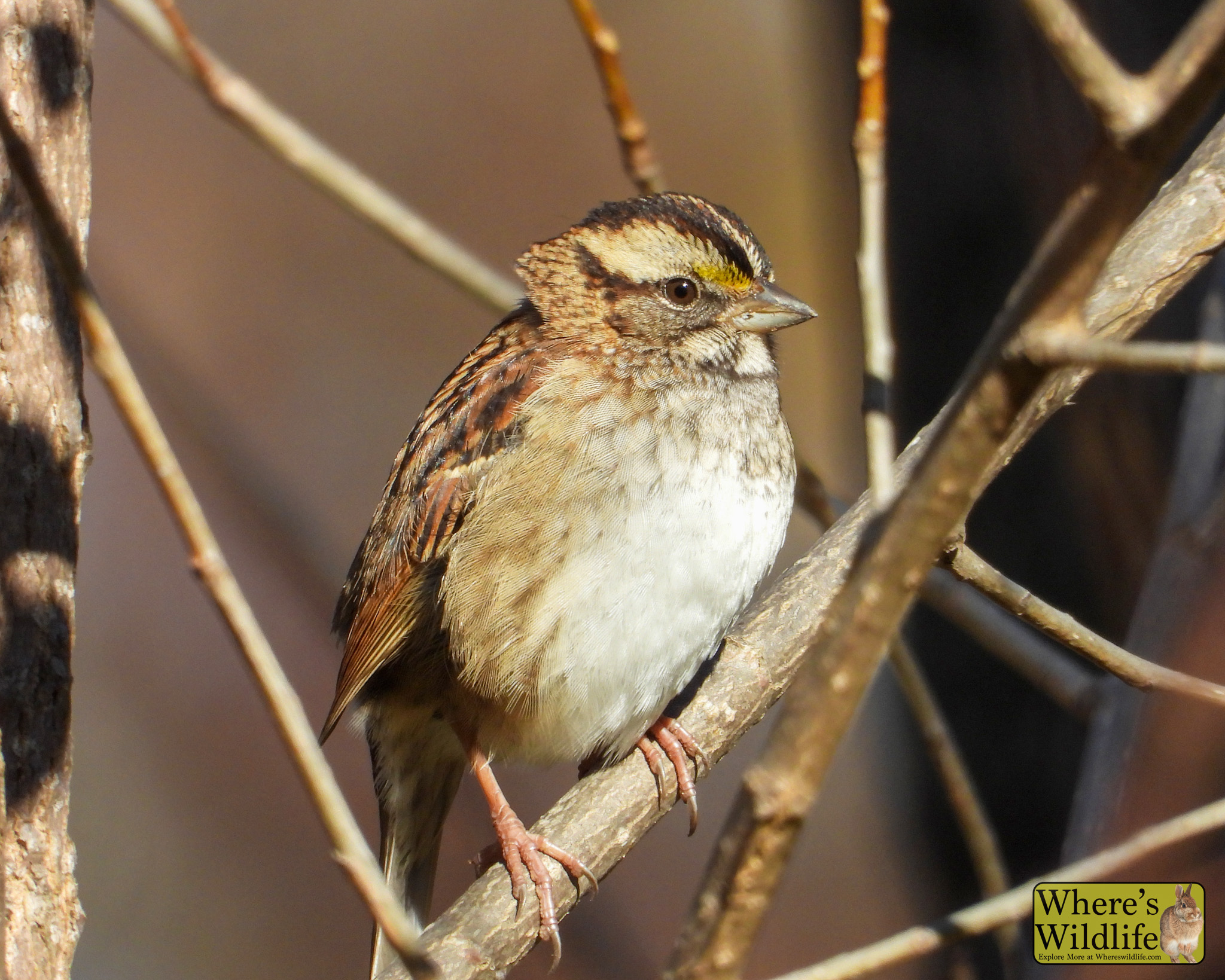
Three Identification Clues
A sharply defined white throat contrasts with the gray face and breast.
Look for yellow between the eye and the gray bill.
Adults occur in white-striped and tan-striped head patterns; these are color forms, not simply different ages or sexes.
Field Photographs
Showing all 7 photographs.


Beyond the first impression
Plumage & Identification
Read the throat and face together
A neat white throat contrasts with the gray chest. Yellow patches just in front of the eyes and a grayish bill help distinguish this bird from the similarly striped White-crowned Sparrow. Check those small features before relying on crown stripes alone. [1]
A tan crown is normal too
Tan-striped birds have a buff-and-brown head pattern rather than crisp black and white. Juveniles can be heavily streaked below. The full-bodied shape, relatively long tail, and throat pattern deserve attention when a bird does not match the boldest adult photograph. [1]
Life history
How This Bird Lives
Where to look
Watch beneath shrubs and along wooded edges, especially where leaf litter meets open feeding ground. Winter flocks sometimes sing their clear, wavering whistles even outside the nesting season. Pause near cover and let feeding birds come into view. [3]
Food & foraging
Both feet can sweep leaves backward before the bird hops forward to inspect the exposed surface. Seeds and fruit are important foods; summer brings more insects and other small animals. Nestlings receive an animal-rich diet, while spring adults also nibble buds and blossoms. [2]
A cup beneath the cover
The female builds with moss, grasses, twigs, and other plant material, adding a finer lining. Ferns, shrubs, or dead vegetation often conceal the nest from above. Each attempt uses a newly built nest rather than the old cup. [2]
Clutches contain 1–6 eggs. Incubation lasts about 11–14 days, and nestlings remain roughly 7–12 days. Please observe without parting the vegetation around a suspected nest. [2]
Did you know?
A Closer Look at White-throated Sparrows
Different stripes, frequent partners
The two adult color forms are inherited. Breeding pairs usually combine a white-striped bird with a tan-striped bird, helping maintain both forms in the population. [3]
An unexpected relative in the nest
Occasional hybrids occur with Dark-eyed Juncos. Their mixed markings are a reminder that not every unusual sparrow fits a standard field-guide illustration. [3]
A second attempt may be higher
After losing a ground nest, a pair sometimes nests above the ground in a shrub or conifer. Ground nesting is typical, but it is not an absolute rule. [3]
Sources: [1] Cornell · Identification [2] Cornell · Life history [3] Cornell · Species overview
Range & Sightings
Seasonal Range
View Range Map ↗Recorded Observations
Observation records are not a complete seasonal range map.
iNaturalist observation map ↗