Pronounced (approximate): ROO-bus oh-dor-AY-tuss
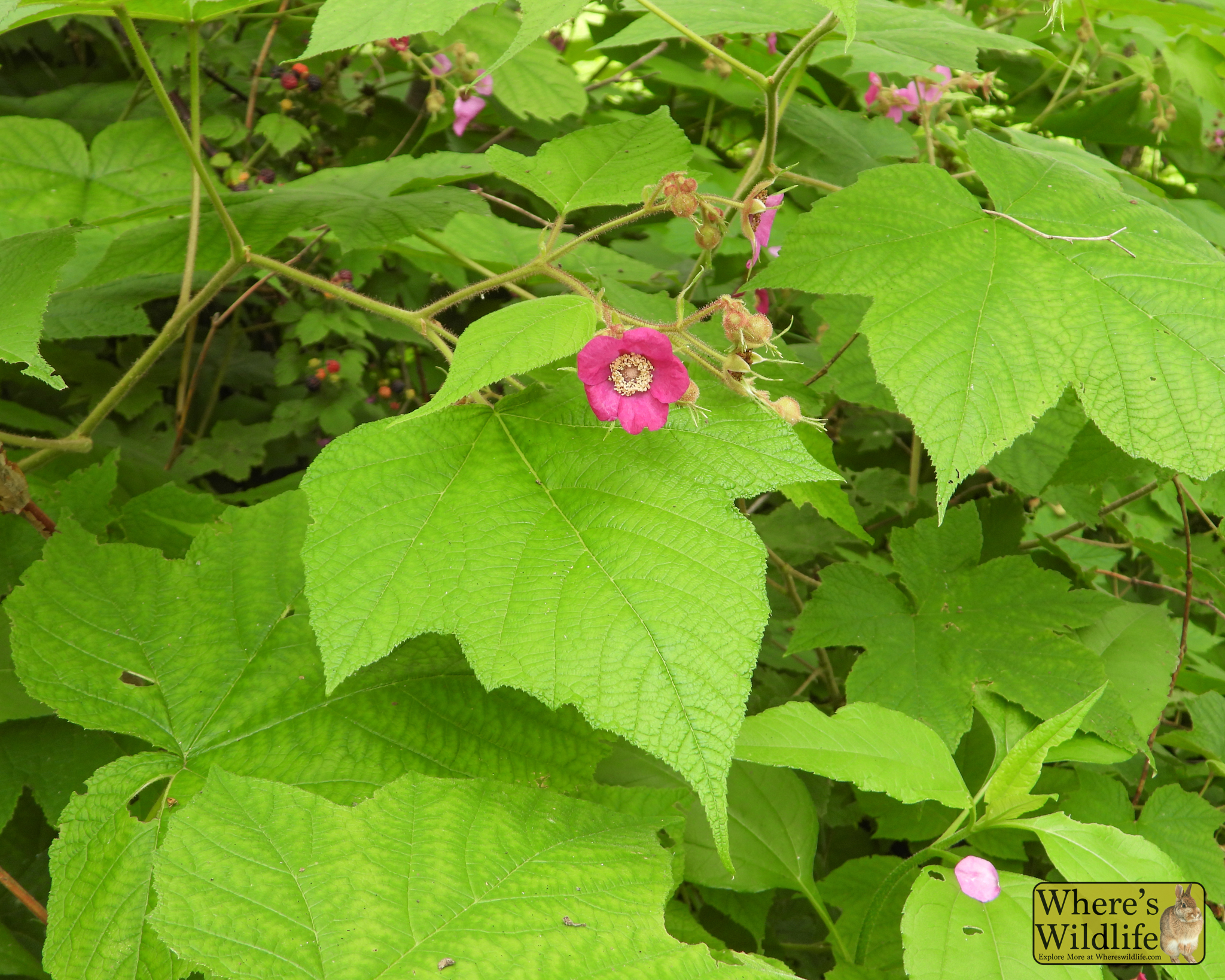
Large pink-purple flowers have five broad petals. Hairy woody canes have few or no prickles.
Family Rosaceae
Life cycle Deciduous shrub
Blooms Late spring–summer
Height 3–6 feet
Habitat Woodland edges, rocky woods, and thickets
Common names
Purple Flowering Raspberry · Flowering Raspberry
Bloom timing and height vary with location. Native status refers to North America; see the regional range below.
Explore reported observations. Sightings are not a complete range map.
Woodland edges, rocky woods, and thickets. Flowering season: late spring–summer.
Unlike many raspberries, the leaves are simple rather than divided into separate leaflets.
Large pink-purple flowers have five broad petals.
Large simple leaves have maple-like lobes and toothed edges.
Look for deciduous shrub growth in woodland edges, rocky woods, and thickets. Pair close views with a photograph of the whole plant.
15 field photographs. Select a photograph to enlarge it; use Load more photos to see the rest.
Native primarily to eastern North America; regional records extend beyond the main eastern range.
Reported U.S. native distribution
AL, CT, DE, DC, GA, IL, IN, KY, ME, MD, MA, MI, MO, MT, NH, NJ, NY, NC, OH, PA, RI, TN, VT, VA, WA, WV, WI
State records describe documented distribution, not presence in every county. The observation map shows reported sightings and may include cultivated plants.
Observation maps show submitted records, not every place the plant occurs. Follow local access rules when visiting a site.
Practice recognizing Purple Flowering Raspberry in the flower quiz, or compare it with other plants in the guide.
Field photographs: Where’s Wildlife.
Explore wildlife guides, educational posters, and PNG clipart. Use the filters to narrow your results.