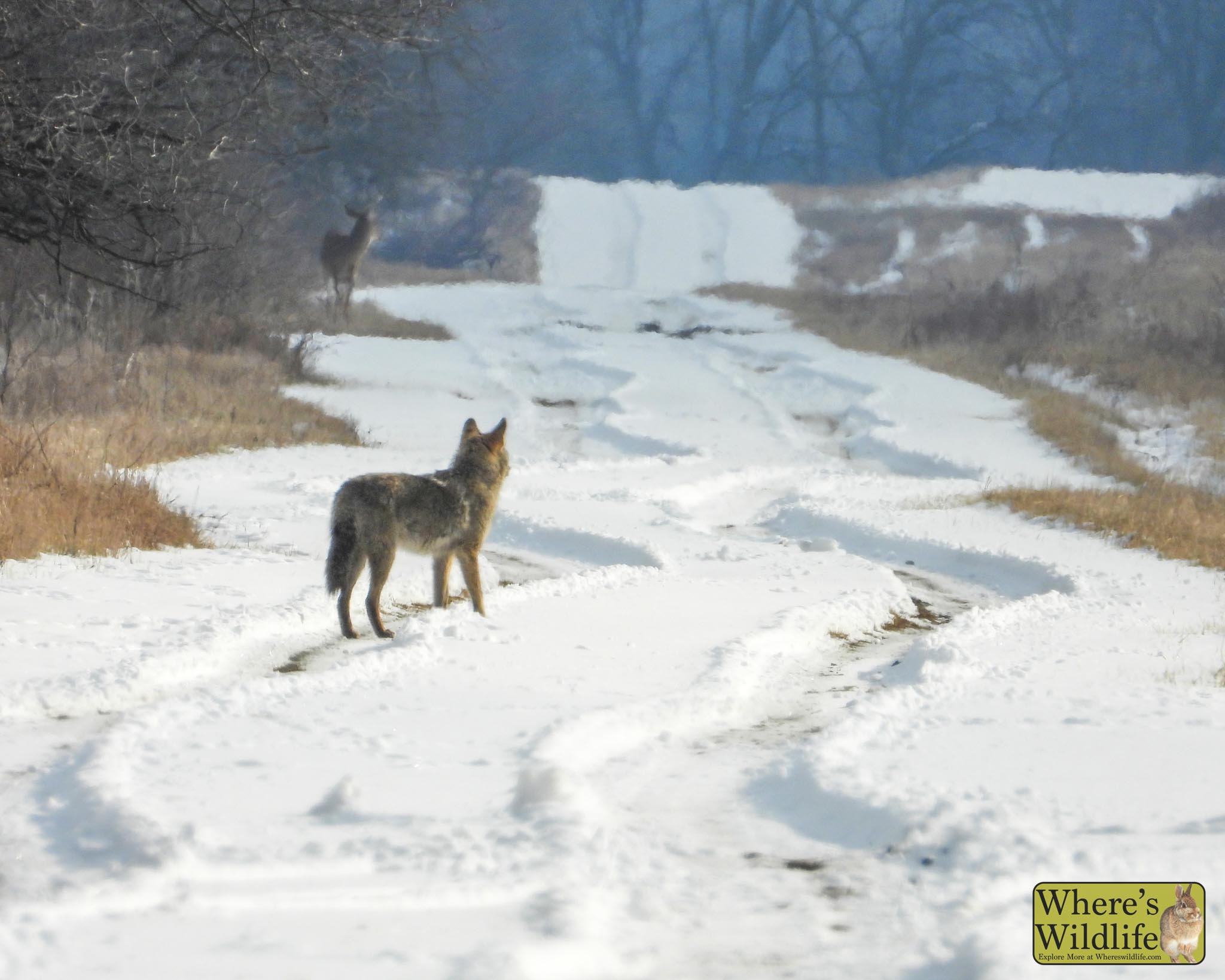
Compare views, markings and body shapes in the photographs below.
Coyote resting in snow and facing the camera.
Coyote standing among dry reeds at the water’s edge.
Coyote standing on a wooded bank beside water.
Coyote standing in snow beside a tree.
Coyote lying on the ground beside fallen branches.
Coyote wading through shallow water and reeds.
Coyote standing beside brush in a snowy clearing.
Coyote standing on a snow-covered track.
Coyote resting in snow among dry stems.
Identification & Look-alikes
What to Look For
A coyote has a lean body, long legs, upright ears and a relatively narrow muzzle. Its coat mixes gray, tan, reddish and dark hairs, with considerable variation between animals. The bushy tail commonly has a dark tip.
A Closer Look
Compared with many domestic dogs, a coyote has a more consistently slender shape and often carries its tail below the level of its back while moving. A Red Fox is smaller and typically has a white-tipped tail. Use shape, movement and setting together.
Habitat & Life History
Food & Habitat
Coyotes live in many environments, from open country to city green spaces. They eat small mammals and other animal prey but also take fruit and carrion. Their flexible diet and habitat use help explain why they occur so widely.
Behavior & Young
A coyote may hunt alone, travel with a mate or belong to a family group. Both parents can help raise the pups, which begin life in a den. Howls, yips, scent marks and body postures help coyotes communicate with one another.
Did You Know?
Flexible menu
Coyotes use both animal and plant foods.
Family life
Seeing one alone does not mean it has no family group.
Listen carefully
Howls and yips can reveal animals hidden from view.
Range & Sightings
Where It Lives
Coyotes occur across much of North and Central America. Their distribution has expanded into many areas, including settled landscapes. Local observation maps show reported encounters, not every place where coyotes live.