


Where’s Wildlife · Bird Field Guide
Winter Wren
Troglodytes hiemalis
Pronounced (approx.): trog-loh-DYE-teez hye-eh-MAL-iss
A tiny, round wren that searches through tangles, fallen logs, and exposed roots.
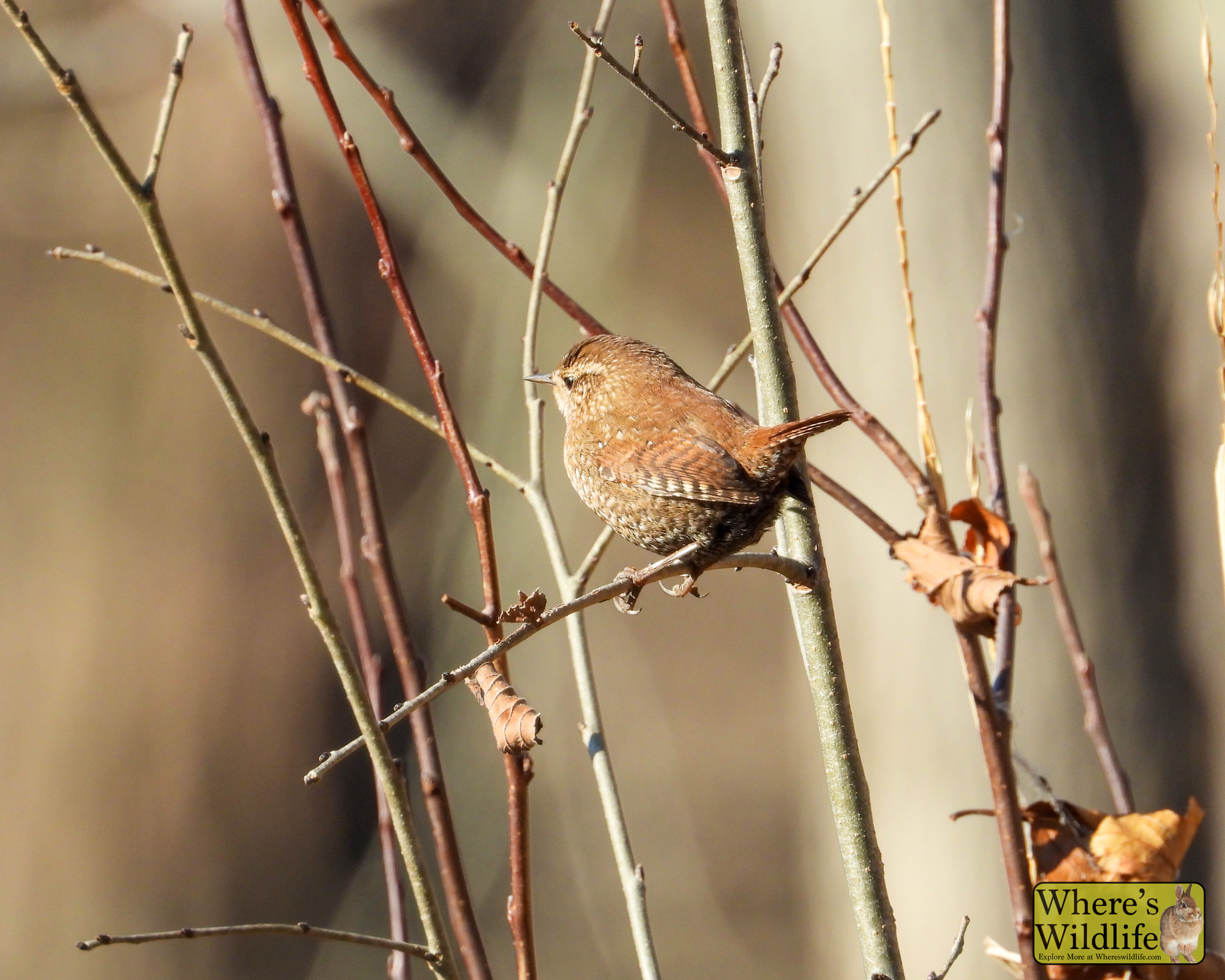
Three Identification Clues
A very short tail is often held upright above a small, rounded body.
Brown plumage has darker barring on the wings, tail, and belly.
A thin bill and pale eyebrow show at close range; watch for quick movements near logs and roots.
Field Photographs
Showing all 2 photographs.


Beyond the first impression
Plumage & Identification
Shape can be clearer than color
The round body and remarkably short tail create a different silhouette from many familiar wrens. In better light, look for a pale eyebrow, an unmarked tan throat, and dark barring across the wings, belly, and tail. Forest shade can make all of these look simply brown. [1]
Follow movement close to the ground
A Winter Wren may bob its whole body before slipping between roots or along a log. Compare that compact outline with our Northern House Wren guide. Do not identify an unfamiliar western bird by appearance alone: Pacific Wren is extremely similar. [1] [3]
Life history
How This Bird Lives
Where to look
Pause near fallen logs and root tangles beside wooded streams. A singing male can be surprisingly conspicuous on a low perch in spring. Winter birds use a wider variety of eastern woodland and brushy places than their deep-forest summer image suggests. [3]
Food & foraging
A fine bill probes decaying bark and crevices for beetles, ants, spiders, and other small animals. Birds also pick prey from low foliage and occasionally eat berries. Fallen wood is therefore a feeding surface, not merely an obstacle to hop over. [2]
Building into the woodland
The male builds with moss, bark, twigs, and nearby plant material. A nest may be tucked into an upturned root mass, decaying log, bank, or other cavity; some are enclosed domes. Both sexes contribute soft lining. [2]
Clutches contain 1–9 eggs. Incubation takes about 14–17 days, and nestlings remain roughly 15–17 days. Leave moss and rotting wood undisturbed around nesting birds. [2]
Did you know?
A Closer Look at Winter Wrens
A choice of nest sites
A male may construct several nests and show them to a prospective mate. The female chooses the one used for breeding; an unused structure is not necessarily an abandoned breeding attempt. [3]
One old name, three species
Winter, Pacific, and Eurasian Wrens were treated as one species until 2010. Their similar appearance contrasts with differences in songs and genetic evidence. Older books may therefore use Winter Wren more broadly. [3]
Not confined to the forest floor
Winter Wrens can cling to trunks much like a Brown Creeper. Their search follows useful crevices and prey, even when that takes them off the ground. [2]
Sources: [1] Cornell · Identification [2] Cornell · Life history [3] Cornell · Species overview
Range & Sightings
Seasonal Range
View Range Map ↗Recorded Observations
Observation records are not a complete seasonal range map.
iNaturalist observation map ↗