


Where’s Wildlife · Bird Field Guide
Wood Duck
Aix sponsa
Pronounced (approx.): AY-iks SPON-suh
A crested duck of wooded wetlands that readily perches on branches and nests in cavities.
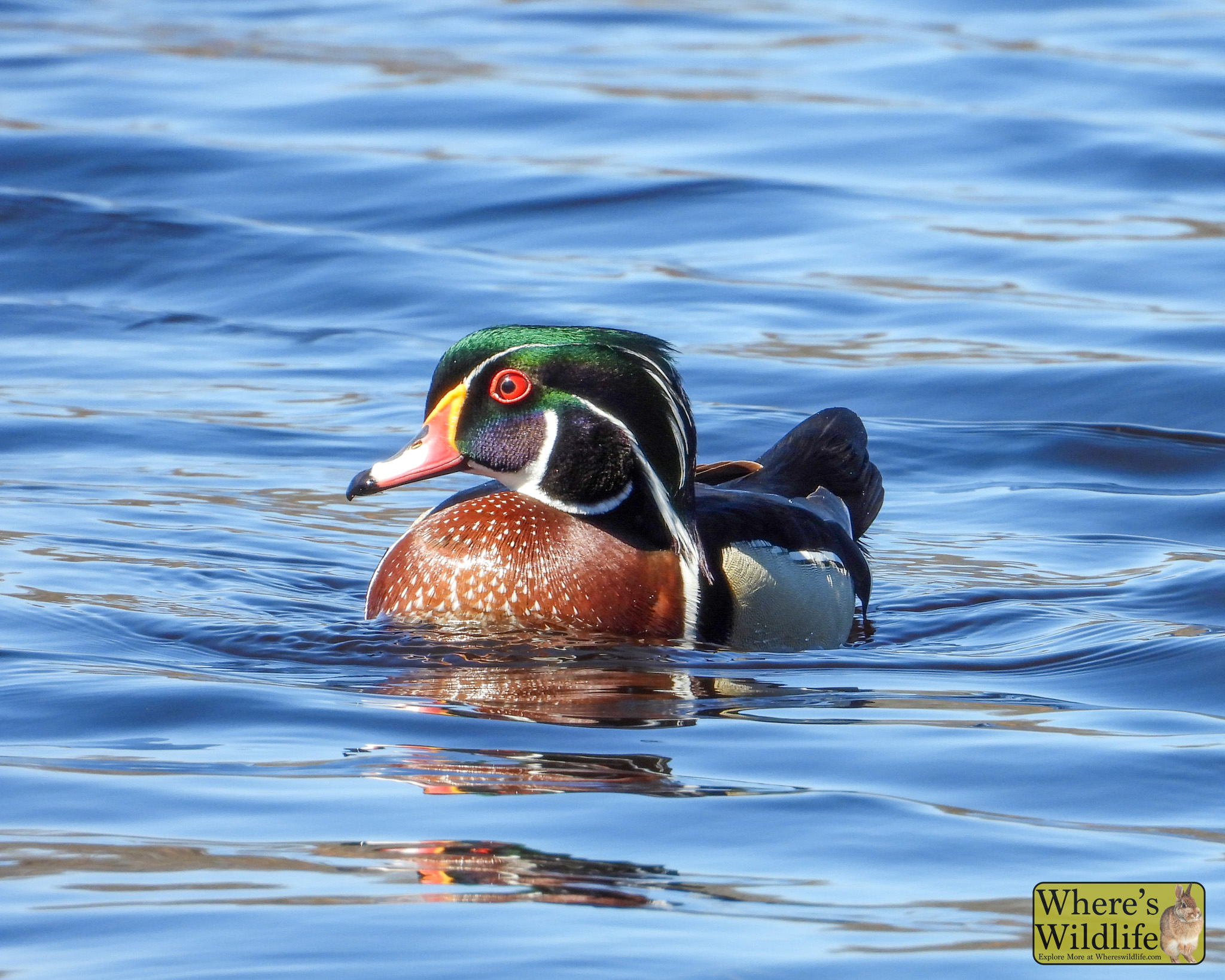
Three Identification Clues
A boxy, crested head, thin neck, and long broad tail create a distinctive shape.
Breeding males have a glossy green head with white markings, a chestnut breast, and pale sides.
Females are gray-brown with a prominent white teardrop-shaped patch around the eye.
Field Photographs
Showing 8 of 21 photographs.


The mixed-bird photograph is included for habitat context, not used as a quiz question.
Beyond the first impression
Plumage & Identification
Look beyond the colorful male
A breeding male combines a striped head, chestnut breast, and pale sides, but harsh or dim light can hide the iridescence. Females have a gray-brown body and distinctive white eye patch. Head shape remains helpful when the colors are difficult to see. [1]
Summer changes the picture
A male in dull postbreeding plumage still has a bright eye and bill. Young birds look much more like females. Compare several views with our Hooded Merganser guide, watching the bill and head outline rather than treating any crested duck as the same species. [1]
Life history
How This Bird Lives
Where to look
Scan sheltered water beside fallen branches, overhanging shrubs, and woodland edges. Wood Ducks often stay near cover instead of gathering in the middle of a large lake. A bird standing on a branch over water is behaving quite naturally. [3]
Food & foraging
Seeds, fruit, and other plant foods make up much of the diet, with insects and other invertebrates added. Birds may leave the water to find acorns or grain. They obtain food by dabbling and sometimes making short, shallow dives. [2]
A high nest and an early jump
Wood Ducks cannot excavate their own cavities. The female selects an existing hollow or suitable box and adds down. Cornell reports 6–16 eggs and an incubation period of about 28–37 days. [2]
Ducklings usually leave about a day after hatching, climbing to the entrance and jumping down. The mother leads them toward water; leaving the cavity is not the same as being able to fly. Please keep their route clear and observe from a distance. [2] [3]
Did you know?
A Closer Look at Wood Ducks
Claws for a wooded world
Strong claws help these ducks grip bark and perch on branches. Their connection to trees involves more than simply having woodland next to a pond. [3]
More than one mother's eggs
Females sometimes lay in another Wood Duck's nest. A very large collection of eggs may therefore come from several birds, not one exceptionally large clutch. Closely spaced nest boxes can encourage this behavior. [3]
Sometimes a second brood
Wood Ducks regularly produce two broods in a year, an unusual ability among North American ducks. That does not mean every female raises two broods in every location or season. [3]
Sources: [1] Cornell · Identification [2] Cornell · Life history [3] Cornell · Species overview
Range & Sightings
Seasonal Range
View Range Map ↗Recorded Observations
Observation records are not a complete seasonal range map.
iNaturalist observation map ↗